SlideShare a Scribd company logo
By Audrey Zahra
Analytical Method
Analytical Method of Wood Component presentation
The amount of the various wood components, viz cellulose, hemicelluloses, lignin, extractives and inorganics can vary widely
depending on wood species. In addition, structural differences exist between the various types of wood tissue as well as
between the individual cell wall layers. Irrespective of morphological differences, the gross composition of wood (or pulp) can
Be determined by first applying a homogenization of the material, followed by solvent extraction to remove low molecular
weight organics.
Introduction
Acid hydrolysis of the residue results in a precipitate consisting of highly condensed lignin (Klason lignin) and a solution of
monomeric sugars. The latter are separated (by GC, HPLC or CE analysis) and quantified whereas the Klason lignin is
determined gravimetrically. For the analysis of inorganics, present in the wood as carbonates, phosphates etc, combustion of
the wood sample and gravimetric determination of the ash can be used. The individual components of the ash can be
further analysed using e.g. inductively coupled plasma mass spectrometry (ICP-MS).
Analytical Method of Wood Component presentation
Periodate oxidation
Wet chemical analyses of carbohydrates and polysaccharides were developed a long time ago and are still in use
frequently although NMR methods can also be used. For the general detection of carbohydrate structures, an
oxidation of the sample with periodate is convenient since periodate reacts with vicinal dihydroxy compounds. In the
reaction, each hydroxyl group is converted to an aldehyde or, for glycerol structures, an additional formation of formic
acid
The separation of the individual polysaccharides present in wood and other lignocellulosic material is not trivial due to the
complex arrangement of polymers making up the cell wall with lignin acting as an incrusting material. The necessary increase
in accessibility of the polysaccharides can be obtained by a selective oxidative degradation of the lignin with sodium chlorite
under mild acid conditions
The further separation of the individual polysaccharide components present in wood can be done with holocellulose as the
starting material. In the complicated separation scheme (Figure 9.4), strong alkali is used to dissolve the predominant portion of
the xylan and galactoglucomannan leaving cellulose and glucomannan as a residue. The fact that sugar units like mannose having
vicinal hydroxyl groups in a cis-configuration can form soluble borate complexes and insoluble barium salts (Figure9.5) can
be used to further separate the individual hemicelluloses.
Analytical Method of Wood Component presentation
The composition, structure and morphology of the polysaccharides present in wood and pulps are of great importance since
these to a major extent determine the properties of the resulting fibers. A simple quantification of the monomeric sugar units
present in a wood or pulp sample can be done as outlined in Figure 9.1. After the acid hydrolysis, the mixture of sugars can be
reduced with sodium borohydride to convert all reducing end-groups to the corresponding alcohol groups. Thereby, only one
product from each pair of anomeric sugar units is obtained. After a subsequent acetylation, the mixture is analysed by gas
chromatography (Figure 9.6). Other separation techniques are also frequently used such as HPLC or CE (capillary electrophoresis)
With or without derivatization.
Sugar compotition
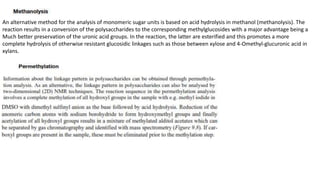
An alternative method for the analysis of monomeric sugar units is based on acid hydrolysis in methanol (methanolysis). The
reaction results in a conversion of the polysaccharides to the corresponding methylglucosides with a major advantage being a
Much better preservation of the uronic acid groups. In the reaction, the latter are esterified and this promotes a more
complete hydrolysis of otherwise resistant glucosidic linkages such as those between xylose and 4-Omethyl-glucuronic acid in
xylans.
Analytical Method of Wood Component presentation
For the isolation of lignin from kraft pulp, methods based on acid and/or enzymatic hydrolysis
of carbohydrate-carbohydrate and lignin-carbohydrate linkages are frequently employed
whereas lignin from alkaline pulping liquors can be isolated by precipitation with acid.
The characteristic feature of a lignin (or lignan) is the presence of aromatic methoxyl groups.
Except for the p-hydroxyphenyl units constituting part of compression wood and grass
lignins, virtually all aromatic units contain at least one methoxyl group. This can be analysed
By reacting the sample with hydriodic acid followed by gas chromatographic analysis of the
methyl iodide that is formed
For the direct chemical analysis of isolated lignin or of lignin present in wood or pulps,
degradation methods employing oxidation with potassium permanganate – hydrogen peroxide
or ozone can be used. Among other methods, acid hydrolysis in the presence of ethanethiol,
thioacidolysis, is the most important. The first of these reactions is outlined in Figure 9.12. In a
four-step procedure, the lignin-containing sample is first alkylated to protect the phenolic
hydroxyl groups. Oxidation in two steps with potassium permanganate and hydrogen peroxide
converts all side-chains to aromatic carboxyl groups and these are finally esterified to provide
derivatives suitable for gas chromatographic analysis.
Analytical Method of Wood Component presentation
Thank you

More Related Content

PPTX
Polymers evs ppt (3)
PPTX
Polymer science
PPTX
Polymers
PPTX
Polymers 12th State Board
PPT
Polymer science: preparation and uses of polymers
PPTX
Dental polymer part 1
Polymers evs ppt (3)
Polymer science
Polymers
Polymers 12th State Board
Polymer science: preparation and uses of polymers
Dental polymer part 1

What's hot (20)

PPT
Polymer in pharmaceutics by prof. TARiQUE khan sir. AACP Akkalkuwa
PPTX
Polymers
PPTX
Polymer science
PPTX
Polymer behaviour in solution & effect of molecular weight in polymer
PPTX
Polymers Used in Pharmaceutical Sciences
PPTX
Introduction of polymer
PPTX
Polymer Gels (Hydrogels)
PPT
Basic of polymer
PPTX
1.0 polymerscience 141002020922-phpapp02 ok
PPTX
Complexation
PPT
Polymer science by raheem
PPTX
Polymers
PPTX
Pharmaceutical Complexation and Protein Binding
PDF
Complexation and protein binding
PPTX
Fuctional group determination of drugs in biological activity.
PPTX
Complexation and protein binding
PPT
Polymer
PPTX
219103 lecture 8
PPTX
Characterization of polymer
Polymer in pharmaceutics by prof. TARiQUE khan sir. AACP Akkalkuwa
Polymers
Polymer science
Polymer behaviour in solution & effect of molecular weight in polymer
Polymers Used in Pharmaceutical Sciences
Introduction of polymer
Polymer Gels (Hydrogels)
Basic of polymer
1.0 polymerscience 141002020922-phpapp02 ok
Complexation
Polymer science by raheem
Polymers
Pharmaceutical Complexation and Protein Binding
Complexation and protein binding
Fuctional group determination of drugs in biological activity.
Complexation and protein binding
Polymer
219103 lecture 8
Characterization of polymer
Ad

Similar to Analytical Method of Wood Component presentation (20)

PPTX
chemical analysis in pulp
PPTX
Acid insoluble lignin in wood and pulp
PDF
Determination of Structural Carbohydrates & Lignin in Biomass
PDF
Rasp 1 93 rapid andsimplemethod
PDF
basics of kraft pulping
PDF
Characterization
PDF
Characterization
PPTX
Chemistry of cell wall.pptx
PPT
Wood bark as valuable raw material for compounds with biological activity
PDF
Characterization of lignins by Py/GC/MS
PDF
Milled iraqi phoenix dactylifera date palm pruning woods lignin qualitative a...
PDF
Relative examination of monosaccharide and disaccharide
PPTX
Lignin Depolymerization and Conversion Utilizing Catalytic Hydrogenolysis
PDF
Pretreatment Methods
PPTX
WOOD CHEMICAL COMPONENTS
PDF
National High-tech R&D Program
PPTX
19. BIOCHEMISTRY AND MICROBIOLOGY FOR ETHANOL PRODUCTION.pptx
DOCX
Project report Kshitij Agarwal (1) (1) (1)
PDF
CHARACTERIZATION AND COMPARISON BY UV SPECTROSCOPY OF PRECIPITATED LIGNINS AN...
PDF
Pineapple fiber properties and uses by vignesh dhanabalan
chemical analysis in pulp
Acid insoluble lignin in wood and pulp
Determination of Structural Carbohydrates & Lignin in Biomass
Rasp 1 93 rapid andsimplemethod
basics of kraft pulping
Characterization
Characterization
Chemistry of cell wall.pptx
Wood bark as valuable raw material for compounds with biological activity
Characterization of lignins by Py/GC/MS
Milled iraqi phoenix dactylifera date palm pruning woods lignin qualitative a...
Relative examination of monosaccharide and disaccharide
Lignin Depolymerization and Conversion Utilizing Catalytic Hydrogenolysis
Pretreatment Methods
WOOD CHEMICAL COMPONENTS
National High-tech R&D Program
19. BIOCHEMISTRY AND MICROBIOLOGY FOR ETHANOL PRODUCTION.pptx
Project report Kshitij Agarwal (1) (1) (1)
CHARACTERIZATION AND COMPARISON BY UV SPECTROSCOPY OF PRECIPITATED LIGNINS AN...
Pineapple fiber properties and uses by vignesh dhanabalan
Ad

More from Audrey Zahra (14)

PPTX
Kraft pulping
PPTX
Ozone bleaching
PPTX
Chemistry of delignification
PPTX
Green solvents in carbohydrate chemistry
PPTX
Rheology
PPTX
Emulsion formation, stability, and rheology
PPTX
Characteristics of Cellulose
PPTX
Filler effect for paper properties
PPTX
biomolecules carbohydrates
PPTX
stereochemistry at tetrahedral centres
PPTX
Cellulose
PPTX
Fibers in paper
PPTX
Coating paper and board
PPTX
Perangkat keras di laboratorium
Kraft pulping
Ozone bleaching
Chemistry of delignification
Green solvents in carbohydrate chemistry
Rheology
Emulsion formation, stability, and rheology
Characteristics of Cellulose
Filler effect for paper properties
biomolecules carbohydrates
stereochemistry at tetrahedral centres
Cellulose
Fibers in paper
Coating paper and board
Perangkat keras di laboratorium

Recently uploaded (20)

PPTX
the solar system janDNsdnfanscssfsaaansf
PPTX
Afro-Asia Literature.pptxmmmmmmmmmmmmmmm
DOCX
Double Membrane Roofs for Digester Tank Wastewater Treatment Integral to biog...
PPTX
AUTO IRRIGATION USING GRID SYSTEM123.pptx
PPTX
Arugula. Crop used for medical plant in kurdistant
PPTX
STL Academy - Highlights & Impact 2020-21-v2 (1).pptx
PPTX
Minor Species of nutmeg, cinnamon and clove
PPTX
Corporate Social Responsibility & Governance
DOCX
Double Membrane Roofs for Anaerobic Digesters Essential for capturing and sto...
PPTX
Environmental pollutants for natural res
PDF
Tree Biomechanics, a concise presentation
PPTX
EME Aerospace.pptx basics of mechanical engineering
DOCX
The Ripple Effect: Understanding Extreme Weather Patterns and Geomagnetic Dyn...
PPTX
Plant_Cell_Presentation.pptx.com learning purpose
DOCX
Double Membrane Roofs for Biomethane Storage Holds upgraded biomethane fuel.docx
PDF
Ornithology-Basic-Concepts.pdf..........
PDF
1748933543SJA_41_2_826-834 SJA Ihsan ullha.pdf
PDF
Cave Diggers Simplified cave survey methods and mapping
PDF
Effective factors on adoption of intercropping and it’s role on development o...
PPTX
Importance of good air quality and different pollutants.
the solar system janDNsdnfanscssfsaaansf
Afro-Asia Literature.pptxmmmmmmmmmmmmmmm
Double Membrane Roofs for Digester Tank Wastewater Treatment Integral to biog...
AUTO IRRIGATION USING GRID SYSTEM123.pptx
Arugula. Crop used for medical plant in kurdistant
STL Academy - Highlights & Impact 2020-21-v2 (1).pptx
Minor Species of nutmeg, cinnamon and clove
Corporate Social Responsibility & Governance
Double Membrane Roofs for Anaerobic Digesters Essential for capturing and sto...
Environmental pollutants for natural res
Tree Biomechanics, a concise presentation
EME Aerospace.pptx basics of mechanical engineering
The Ripple Effect: Understanding Extreme Weather Patterns and Geomagnetic Dyn...
Plant_Cell_Presentation.pptx.com learning purpose
Double Membrane Roofs for Biomethane Storage Holds upgraded biomethane fuel.docx
Ornithology-Basic-Concepts.pdf..........
1748933543SJA_41_2_826-834 SJA Ihsan ullha.pdf
Cave Diggers Simplified cave survey methods and mapping
Effective factors on adoption of intercropping and it’s role on development o...
Importance of good air quality and different pollutants.

Analytical Method of Wood Component presentation

  • 6. The amount of the various wood components, viz cellulose, hemicelluloses, lignin, extractives and inorganics can vary widely depending on wood species. In addition, structural differences exist between the various types of wood tissue as well as between the individual cell wall layers. Irrespective of morphological differences, the gross composition of wood (or pulp) can Be determined by first applying a homogenization of the material, followed by solvent extraction to remove low molecular weight organics. Introduction Acid hydrolysis of the residue results in a precipitate consisting of highly condensed lignin (Klason lignin) and a solution of monomeric sugars. The latter are separated (by GC, HPLC or CE analysis) and quantified whereas the Klason lignin is determined gravimetrically. For the analysis of inorganics, present in the wood as carbonates, phosphates etc, combustion of the wood sample and gravimetric determination of the ash can be used. The individual components of the ash can be further analysed using e.g. inductively coupled plasma mass spectrometry (ICP-MS).
  • 9. Periodate oxidation Wet chemical analyses of carbohydrates and polysaccharides were developed a long time ago and are still in use frequently although NMR methods can also be used. For the general detection of carbohydrate structures, an oxidation of the sample with periodate is convenient since periodate reacts with vicinal dihydroxy compounds. In the reaction, each hydroxyl group is converted to an aldehyde or, for glycerol structures, an additional formation of formic acid
  • 10. The separation of the individual polysaccharides present in wood and other lignocellulosic material is not trivial due to the complex arrangement of polymers making up the cell wall with lignin acting as an incrusting material. The necessary increase in accessibility of the polysaccharides can be obtained by a selective oxidative degradation of the lignin with sodium chlorite under mild acid conditions
  • 11. The further separation of the individual polysaccharide components present in wood can be done with holocellulose as the starting material. In the complicated separation scheme (Figure 9.4), strong alkali is used to dissolve the predominant portion of the xylan and galactoglucomannan leaving cellulose and glucomannan as a residue. The fact that sugar units like mannose having vicinal hydroxyl groups in a cis-configuration can form soluble borate complexes and insoluble barium salts (Figure9.5) can be used to further separate the individual hemicelluloses.
  • 13. The composition, structure and morphology of the polysaccharides present in wood and pulps are of great importance since these to a major extent determine the properties of the resulting fibers. A simple quantification of the monomeric sugar units present in a wood or pulp sample can be done as outlined in Figure 9.1. After the acid hydrolysis, the mixture of sugars can be reduced with sodium borohydride to convert all reducing end-groups to the corresponding alcohol groups. Thereby, only one product from each pair of anomeric sugar units is obtained. After a subsequent acetylation, the mixture is analysed by gas chromatography (Figure 9.6). Other separation techniques are also frequently used such as HPLC or CE (capillary electrophoresis) With or without derivatization. Sugar compotition
  • 14. An alternative method for the analysis of monomeric sugar units is based on acid hydrolysis in methanol (methanolysis). The reaction results in a conversion of the polysaccharides to the corresponding methylglucosides with a major advantage being a Much better preservation of the uronic acid groups. In the reaction, the latter are esterified and this promotes a more complete hydrolysis of otherwise resistant glucosidic linkages such as those between xylose and 4-Omethyl-glucuronic acid in xylans.
  • 16. For the isolation of lignin from kraft pulp, methods based on acid and/or enzymatic hydrolysis of carbohydrate-carbohydrate and lignin-carbohydrate linkages are frequently employed whereas lignin from alkaline pulping liquors can be isolated by precipitation with acid.
  • 17. The characteristic feature of a lignin (or lignan) is the presence of aromatic methoxyl groups. Except for the p-hydroxyphenyl units constituting part of compression wood and grass lignins, virtually all aromatic units contain at least one methoxyl group. This can be analysed By reacting the sample with hydriodic acid followed by gas chromatographic analysis of the methyl iodide that is formed
  • 18. For the direct chemical analysis of isolated lignin or of lignin present in wood or pulps, degradation methods employing oxidation with potassium permanganate – hydrogen peroxide or ozone can be used. Among other methods, acid hydrolysis in the presence of ethanethiol, thioacidolysis, is the most important. The first of these reactions is outlined in Figure 9.12. In a four-step procedure, the lignin-containing sample is first alkylated to protect the phenolic hydroxyl groups. Oxidation in two steps with potassium permanganate and hydrogen peroxide converts all side-chains to aromatic carboxyl groups and these are finally esterified to provide derivatives suitable for gas chromatographic analysis.