SlideShare a Scribd company logo
By: Elen B. Sim
Mainstreaming
Social and instructional integration of students
with disabilities into educational programs
whose primary purpose is to serve typically
developing individuals (Gargiulo & Metcalf,
2010).
Mainstreaming
Placement of students with disabilities – often
part-time – into general class settings
(Mastropieri & Scruggs, 2000).
Least Restrictive Environment
To the maximum extent appropriate, children with disabilities,
including children in public or private institutions or other care
facilities, [will be] educated with children who are not disabled,
and that special classes, separate schooling or other removal
of children with disabilities from the regular educational
environment [may occur] only when the nature or severity of
the disability is such that education in regular classes with the
use of supplementary aids and services cannot be achieved
satisfactorily.
(20 U.S.C., Sec. 1412 [a] [5])
Least Restrictive Environment
 IDEA requires that every student with
disabilities be educated in environments
as close as possible to the general
education classroom setting.
 It is not a place but a concept.
Segregated
Least
Restrictive
Environment
Full
Inclusion
Evolution of Placement Options for Children with Disabilities
Inclusion
- A philosophy in education that includes
students with disabilities as valued
members of the school community
(McLeskey, Rosenberg & Westling, 2010).
Inclusion
- Educating students with disabilities in
regular classrooms (Heward, 2006).
Inclusion
Students with disabilities are served
primarily in the general education
classroom, under the responsibility of the
general classroom teacher (Mastropieri &
Scruggs, 2000).
Full Inclusion
All children with disabilities should be taught
exclusively (with appropriate support) in general
education classrooms at neighborhood schools
– that is, in the same school and age/grade
appropriate classrooms they would attend if they
were not disabled (Gargiulo & Metcalf, 2010).
Full inclusion - Special Education
Key Elements of Full Inclusion Models
“Homeschool” attendance.
Defined as the local school the child
would attend if not disabled.
Key Elements of Full Inclusion Models
Natural proportion at the school site.
The percentage of children with special
needs is in proportion to the percentage
of pupil with exceptionalities.
Key Elements of Full Inclusion Models
Zero rejection.
All students are accepted at the local school,
including those with severe impairments; pupils
are not screened out or grouped separately
because of their disability.
Key Elements of Full Inclusion Models
Age/grade-appropriate placement.
A full-inclusion model calls for serving children with
special needs in general education classrooms
according to their chronological age rather than
basing services on the child’s academic ability
or mental age.
Site-based management or coordination.
Recent trends in school organizational reform suggest
a movement away from central office administration for
sped programs to one where the building principal (or
other administrator) plays a large role in planning and
administering programs for all children in the school.
Key Elements of Full Inclusion Models
Use of cooperative learning and peer
instructional models.
Instructional practices that involve children
learning in a cooperative manner rather than in
a competitive fashion and using students to
Key Elements of Full Inclusion Models
assist in the instruction of classmates with
disabilities can be effective strategies
integrating exceptional learners in the general
education classroom.
Key Elements of Full Inclusion Models
Conceptualization of Integration, Mainstreaming and Inclusion
NORMALIZATION
Integration Mainstreaming Inclusion
Placement in the regular
class in one or more
subjects/activities
Provisions of interaction with
regular children, with the
SPED class remaining as the
child’s station
May include:
Tutorial and other learning-
assistance programs
May involve ancillary
and/or auxiliary services
Placement in the regular
class after fulfilling specific
admission requirements
Provisions of interaction with
regular children, with the
regular class as the
child’s station
May include:
• Shadow teaching in the regular class
• pull-out provision for one-on-one
• individualization in the special class
May involve ancillary
and/or auxiliary services
Placement in the regular
class on the basis of age
regardless of background,
disability and its degree of
severity
No pull-out
No shadow teaching
May involve auxiliary
services outside school
and/or ancillary services
after class sessions
Individualization within
the class without pullout
Individualization within or
outside the class
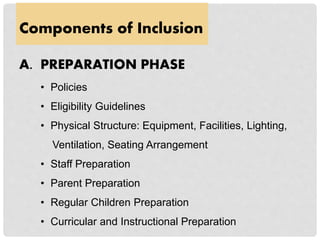
Components of Inclusion
A. PREPARATION PHASE
• Policies
• Eligibility Guidelines
• Physical Structure: Equipment, Facilities, Lighting,
Ventilation, Seating Arrangement
• Staff Preparation
• Parent Preparation
• Regular Children Preparation
• Curricular and Instructional Preparation
Components of Inclusion
B. IMPLEMENTATION PHASE
• Instructional Individualization
• Collaboration with Parents
• Networking with Support-Service Givers
• Materials Production/Technology Utilization
• Child Program Management
Components of Inclusion
C. EVALUATION AND SUSTENANCE PHASE
• Continuous – Progression Scheme
• Evaluation in Relation to Criterion-Referenced
Teaching
• Multidisciplinary Team Evaluation
• Collaboration with the Community: NGOs and GOs
• Family Commitment
• Transition
Teaching Strategies in Inclusive Settings
P rioritize objectives.
Teaching Strategies in Inclusive Settings
A dapt instruction, materials, or the environment.
Teaching Strategies in Inclusive Settings
S ystematic instruction variables duringUse
instruction.
Teaching Strategies in Inclusive Settings
S ystematic evaluation procedures.Implement
Continuum of educational services for Students with disabilities
Full inclusion - Special Education
Best Practices for Staff in Inclusive and Community Settings
 Focus on discerning the differences between students with severe
disabilities and their able-bodied peers
 Instruction across environments with a variety of “teachers”
 Structured, sustained interactions
 Participation in a variety of age-appropriate activities
 A functional life skills curriculum
 Teaching in natural contexts
 An integrated teaching model, in which teachers, parents and
therapists work together to determine basic school needs
 A commitment to work and independent living in the future
Additional best practices are:
 Collaboration among teachers
 Diversity of all students
 Celebration of diversity
 Standards success for all students bring together the goals of
general and special education

More Related Content

PPT
School's Readiness for Inclusion ( B.Ed )
PPTX
Salamanca statement on special education
PPTX
Concept of integrated education
PPTX
Models of inclusive education
PPT
Inclusive Education
PPTX
Team teaching
PPTX
ALBERT BANDURA Social Learning Theory
PPTX
Conversion of measures of length ppt-grade 3
School's Readiness for Inclusion ( B.Ed )
Salamanca statement on special education
Concept of integrated education
Models of inclusive education
Inclusive Education
Team teaching
ALBERT BANDURA Social Learning Theory
Conversion of measures of length ppt-grade 3

What's hot (20)

PDF
Presentation on integration and inclusion
PPTX
Reconstrutionalist curriculum
 
PPTX
Inclusive education
PPTX
Foundations of curriculum
PPTX
inclusive education
PPTX
Humanistic curriculum
PPTX
presentation on difference between special,integrated and inclusive education
PPTX
1. special education
PPT
Benefits of inclusive education
PPT
Curriculum models and types
PPTX
Dimensions of curriculum design
PPTX
Elements/Components of Curriculum
PPTX
The Indicators of Quality Education
PPTX
Curriculum change
PPTX
Analysis on curriculum
PPTX
Barriers to inclusive education
PPTX
Curriculum its meaning, nature and scope
PPTX
Inclusive education
PPTX
Sociological foundation of curriculum
PPTX
Inclusive education
Presentation on integration and inclusion
Reconstrutionalist curriculum
 
Inclusive education
Foundations of curriculum
inclusive education
Humanistic curriculum
presentation on difference between special,integrated and inclusive education
1. special education
Benefits of inclusive education
Curriculum models and types
Dimensions of curriculum design
Elements/Components of Curriculum
The Indicators of Quality Education
Curriculum change
Analysis on curriculum
Barriers to inclusive education
Curriculum its meaning, nature and scope
Inclusive education
Sociological foundation of curriculum
Inclusive education
Ad

Similar to Full inclusion - Special Education (20)

PPTX
topic - Normalization maintreaming and incluion
PPTX
Inclusive education ppt
PPTX
Artificial Intelligence Presentation (2).pptx
PPTX
SPECIAL EDUCATION.pptx
PPTX
unit-3-SPED.pptx
DOCX
KEY DEBATES ON INCLUSIVE EDUCATION INCLUSIVE EDUCATION:
PDF
565982884-Definition-Goals-and-Scope-of-Special-And.pdf
PDF
Bridging the Gap_ Transitioning Children with Multiple Disabilities_ Special ...
PPT
Addressing Issues of Access, Equity and Participation - Saint Lucia
PPTX
Introduction-to-Inclusive-Education.pptx
PPTX
"History of inclusive education".pptx>>>
PPTX
SPPU S.Y.B.Ed. Course Code BED-203 Unit -1 INTRODUCTION OF INCLUSIVE EDUCA...
PPTX
CHAPTER-3.pptx hahahahahadjsjdbfjdjshshdh
PDF
(346408406) inclusive education pdf
DOCX
Inclusive education pdf
PPTX
INCLUSIVE EDUCATION BY RAJESH VASHISTH kvsguru
PPTX
inclusive education
PPTX
Inclusion
PPTX
ETS_Assignment.pptx
PDF
Inclusive education pdf
topic - Normalization maintreaming and incluion
Inclusive education ppt
Artificial Intelligence Presentation (2).pptx
SPECIAL EDUCATION.pptx
unit-3-SPED.pptx
KEY DEBATES ON INCLUSIVE EDUCATION INCLUSIVE EDUCATION:
565982884-Definition-Goals-and-Scope-of-Special-And.pdf
Bridging the Gap_ Transitioning Children with Multiple Disabilities_ Special ...
Addressing Issues of Access, Equity and Participation - Saint Lucia
Introduction-to-Inclusive-Education.pptx
"History of inclusive education".pptx>>>
SPPU S.Y.B.Ed. Course Code BED-203 Unit -1 INTRODUCTION OF INCLUSIVE EDUCA...
CHAPTER-3.pptx hahahahahadjsjdbfjdjshshdh
(346408406) inclusive education pdf
Inclusive education pdf
INCLUSIVE EDUCATION BY RAJESH VASHISTH kvsguru
inclusive education
Inclusion
ETS_Assignment.pptx
Inclusive education pdf
Ad

Recently uploaded (20)

PDF
RTP_AR_KS1_Tutor's Guide_English [FOR REPRODUCTION].pdf
PPTX
Orientation - ARALprogram of Deped to the Parents.pptx
PDF
A GUIDE TO GENETICS FOR UNDERGRADUATE MEDICAL STUDENTS
PPTX
Onco Emergencies - Spinal cord compression Superior vena cava syndrome Febr...
PPTX
Tissue processing ( HISTOPATHOLOGICAL TECHNIQUE
PDF
Practical Manual AGRO-233 Principles and Practices of Natural Farming
PPTX
Final Presentation General Medicine 03-08-2024.pptx
PDF
OBE - B.A.(HON'S) IN INTERIOR ARCHITECTURE -Ar.MOHIUDDIN.pdf
PDF
Complications of Minimal Access Surgery at WLH
PPTX
UV-Visible spectroscopy..pptx UV-Visible Spectroscopy – Electronic Transition...
PPTX
Lesson notes of climatology university.
PDF
Classroom Observation Tools for Teachers
PDF
Supply Chain Operations Speaking Notes -ICLT Program
DOC
Soft-furnishing-By-Architect-A.F.M.Mohiuddin-Akhand.doc
PDF
LNK 2025 (2).pdf MWEHEHEHEHEHEHEHEHEHEHE
PPTX
Introduction-to-Literarature-and-Literary-Studies-week-Prelim-coverage.pptx
PDF
GENETICS IN BIOLOGY IN SECONDARY LEVEL FORM 3
PDF
RMMM.pdf make it easy to upload and study
PDF
1_English_Language_Set_2.pdf probationary
PDF
LDMMIA Reiki Yoga Finals Review Spring Summer
RTP_AR_KS1_Tutor's Guide_English [FOR REPRODUCTION].pdf
Orientation - ARALprogram of Deped to the Parents.pptx
A GUIDE TO GENETICS FOR UNDERGRADUATE MEDICAL STUDENTS
Onco Emergencies - Spinal cord compression Superior vena cava syndrome Febr...
Tissue processing ( HISTOPATHOLOGICAL TECHNIQUE
Practical Manual AGRO-233 Principles and Practices of Natural Farming
Final Presentation General Medicine 03-08-2024.pptx
OBE - B.A.(HON'S) IN INTERIOR ARCHITECTURE -Ar.MOHIUDDIN.pdf
Complications of Minimal Access Surgery at WLH
UV-Visible spectroscopy..pptx UV-Visible Spectroscopy – Electronic Transition...
Lesson notes of climatology university.
Classroom Observation Tools for Teachers
Supply Chain Operations Speaking Notes -ICLT Program
Soft-furnishing-By-Architect-A.F.M.Mohiuddin-Akhand.doc
LNK 2025 (2).pdf MWEHEHEHEHEHEHEHEHEHEHE
Introduction-to-Literarature-and-Literary-Studies-week-Prelim-coverage.pptx
GENETICS IN BIOLOGY IN SECONDARY LEVEL FORM 3
RMMM.pdf make it easy to upload and study
1_English_Language_Set_2.pdf probationary
LDMMIA Reiki Yoga Finals Review Spring Summer

Full inclusion - Special Education

  • 2. Mainstreaming Social and instructional integration of students with disabilities into educational programs whose primary purpose is to serve typically developing individuals (Gargiulo & Metcalf, 2010).
  • 3. Mainstreaming Placement of students with disabilities – often part-time – into general class settings (Mastropieri & Scruggs, 2000).
  • 4. Least Restrictive Environment To the maximum extent appropriate, children with disabilities, including children in public or private institutions or other care facilities, [will be] educated with children who are not disabled, and that special classes, separate schooling or other removal of children with disabilities from the regular educational environment [may occur] only when the nature or severity of the disability is such that education in regular classes with the use of supplementary aids and services cannot be achieved satisfactorily. (20 U.S.C., Sec. 1412 [a] [5])
  • 5. Least Restrictive Environment  IDEA requires that every student with disabilities be educated in environments as close as possible to the general education classroom setting.  It is not a place but a concept.
  • 7. Inclusion - A philosophy in education that includes students with disabilities as valued members of the school community (McLeskey, Rosenberg & Westling, 2010).
  • 8. Inclusion - Educating students with disabilities in regular classrooms (Heward, 2006).
  • 9. Inclusion Students with disabilities are served primarily in the general education classroom, under the responsibility of the general classroom teacher (Mastropieri & Scruggs, 2000).
  • 10. Full Inclusion All children with disabilities should be taught exclusively (with appropriate support) in general education classrooms at neighborhood schools – that is, in the same school and age/grade appropriate classrooms they would attend if they were not disabled (Gargiulo & Metcalf, 2010).
  • 12. Key Elements of Full Inclusion Models “Homeschool” attendance. Defined as the local school the child would attend if not disabled.
  • 13. Key Elements of Full Inclusion Models Natural proportion at the school site. The percentage of children with special needs is in proportion to the percentage of pupil with exceptionalities.
  • 14. Key Elements of Full Inclusion Models Zero rejection. All students are accepted at the local school, including those with severe impairments; pupils are not screened out or grouped separately because of their disability.
  • 15. Key Elements of Full Inclusion Models Age/grade-appropriate placement. A full-inclusion model calls for serving children with special needs in general education classrooms according to their chronological age rather than basing services on the child’s academic ability or mental age.
  • 16. Site-based management or coordination. Recent trends in school organizational reform suggest a movement away from central office administration for sped programs to one where the building principal (or other administrator) plays a large role in planning and administering programs for all children in the school. Key Elements of Full Inclusion Models
  • 17. Use of cooperative learning and peer instructional models. Instructional practices that involve children learning in a cooperative manner rather than in a competitive fashion and using students to Key Elements of Full Inclusion Models
  • 18. assist in the instruction of classmates with disabilities can be effective strategies integrating exceptional learners in the general education classroom. Key Elements of Full Inclusion Models
  • 19. Conceptualization of Integration, Mainstreaming and Inclusion NORMALIZATION Integration Mainstreaming Inclusion Placement in the regular class in one or more subjects/activities Provisions of interaction with regular children, with the SPED class remaining as the child’s station May include: Tutorial and other learning- assistance programs May involve ancillary and/or auxiliary services Placement in the regular class after fulfilling specific admission requirements Provisions of interaction with regular children, with the regular class as the child’s station May include: • Shadow teaching in the regular class • pull-out provision for one-on-one • individualization in the special class May involve ancillary and/or auxiliary services Placement in the regular class on the basis of age regardless of background, disability and its degree of severity No pull-out No shadow teaching May involve auxiliary services outside school and/or ancillary services after class sessions Individualization within the class without pullout Individualization within or outside the class
  • 20. Components of Inclusion A. PREPARATION PHASE • Policies • Eligibility Guidelines • Physical Structure: Equipment, Facilities, Lighting, Ventilation, Seating Arrangement • Staff Preparation • Parent Preparation • Regular Children Preparation • Curricular and Instructional Preparation
  • 21. Components of Inclusion B. IMPLEMENTATION PHASE • Instructional Individualization • Collaboration with Parents • Networking with Support-Service Givers • Materials Production/Technology Utilization • Child Program Management
  • 22. Components of Inclusion C. EVALUATION AND SUSTENANCE PHASE • Continuous – Progression Scheme • Evaluation in Relation to Criterion-Referenced Teaching • Multidisciplinary Team Evaluation • Collaboration with the Community: NGOs and GOs • Family Commitment • Transition
  • 23. Teaching Strategies in Inclusive Settings P rioritize objectives.
  • 24. Teaching Strategies in Inclusive Settings A dapt instruction, materials, or the environment.
  • 25. Teaching Strategies in Inclusive Settings S ystematic instruction variables duringUse instruction.
  • 26. Teaching Strategies in Inclusive Settings S ystematic evaluation procedures.Implement
  • 27. Continuum of educational services for Students with disabilities
  • 30. Best Practices for Staff in Inclusive and Community Settings  Focus on discerning the differences between students with severe disabilities and their able-bodied peers  Instruction across environments with a variety of “teachers”  Structured, sustained interactions  Participation in a variety of age-appropriate activities  A functional life skills curriculum  Teaching in natural contexts
  • 31.  An integrated teaching model, in which teachers, parents and therapists work together to determine basic school needs  A commitment to work and independent living in the future Additional best practices are:  Collaboration among teachers  Diversity of all students  Celebration of diversity  Standards success for all students bring together the goals of general and special education