SlideShare a Scribd company logo
The computer as a modelling machine
    a history of analog computing

                    Charles Care
          http://www.warwick.ac.uk/go/ccare

                   26th June 2006
History of computing
• Story of the progression of
  technology

• Popular to trace the history
  back to
    – calculating machines (e.g.
      abacus, sliderule)
    – data processing
      technologies (e.g. punched
      cards)
    – early office machinery (e.g.
      typewriters)
    – early communications
      technology (e.g. telegraphs)
Computers and Engineers
• Use computers to represent physical systems
  and natural phenomena
• … problem solving mediated by
  – …differential equations
  – …other notations
• …computers solve the problem by
  – …numerical methods
  – …more direct techniques
• Supported by engineering knowledge,
  experience and trust.
An alternative history
A recent conference... attempted to map out the history
    of software, considering it as science, engineering,
      labour process, reliable artefact and industry...
The focus lay on software and its production as general
     phenomena. What the conference missed was
  software as model, software as experience, software
      as medium of thought and action, software as
     environment within which people work and live.
It did not consider the question of how we have put the
                   world into computers.
                                   (Mahoney, 2005)
From experimental to computational
 • Progression from one-off modelling to the
   development of a laboratory science of
   aeronautics.
   –   Full size
   –   one-off model
   –   model in wind tunnel
   –   electrolytic tank (special purpose analog)
   –   general purpose analog
   –   general purpose digital.
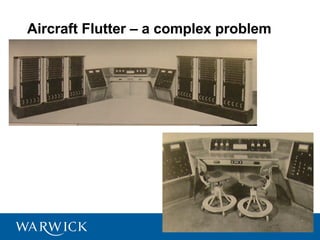
Aircraft Flutter – a complex problem

…flutter calculations required on a modern
 aircraft are usually beyond the scope of a
 desk calculating machine, and high speed
 computational aids have become a necessary
 adjunct to flutter prediction. (Templeton,
 1955)

• Royal Aircraft Establishment developed
  ‘flutter simulators’ (analog computers)
Aircraft Flutter – a complex problem
Aeronautics and analog/digital
• ARC computation panel
  – Wilkes: “No desire to discourage anybody from
    doing work which may get results, but in the near
    future when there were more digital machines …
    analogue machine building just would not be able
    to keep up with them.”
  – “Diprose viewed with alarm the implied tendency
    to build up large programmes and so have the
    arithmetical processes divorced from the physical
    problem.”
                             (Meeting 3 pp 2 – 3, 1953)
Why did analog persist?
• Superiority of digital was understood
• But digital was not fast enough
• Issues relating to training engineers in
  programming
• Engineering trust – how reliable is a program
• Closed shop computing vs open shop
  interaction
• Users rather than inventors.
My research
• The history of an analog computer installed at
  British Petroleum (BP)
• The role of analog computers in higher
  education (HE), and the agency of higher
  education in the development of analog
• Analog/digital applications and use in
  aeronautics
• The relationship between analog computing
  and ‘soft’ computing.
Analog computing at BP


EMIAC computer installed at
BP, Sunbury (1962)
Analog Computer in HE
Modelling machines
• Engineering knowledge and modelling
• Campbell-Kelly and Aspray (2004)
  – Focus: Office machines, communication, and data
    processing
  – Theme: computer as information machine
• My work
  – Focus: Modelling, engineering design, simulation,
    and analog computers
  – Theme: computer as modelling machine
Aeronautics and analog/digital
• Perceptions of superiority
  – “…when the automatic digital machine became
    established…[many suggested] that analogue was
    obsolete. This view is no less widely held.”
                                        (Diprose, 1955)
• Trial and error process
  – “The analogue machine… is more convenient
    where the problem is itself tentative and
    experimental… where the choice of later
    calculations may depend on the results of earlier
    ones.”            (Hollingdale and Diprose, 1953)
Post WWII analog computing
• Problems with this
  history
  – View past with the
    eyes of the present
  – Focus on successes
    rather than failure
  – Small (2001)
  – c.f. Hamilton (1997)
Role of Users
• Cybernetic story
  – Role of feedback
  – Humans and
    Machines working
    together.
  – Mindell (2002)
• Connections with
  Empirical Modelling
  – Human Computing
References
•   Anon. Minutes of the Computation Panel of the ARC. TNA DSIR
    22/206. 1952-3.
•   K. V. Diprose. Analogue computing in aeronautics. Copy of of a lecture
    given to the Royal Aeronautical Society. TNA DSIR 23/23384, 1955.
•   Martin Campbell-Kelly and William Aspray. Computer: A History of the
    Information Machine. 2nd. ed., Westview Press, Colarado, 2004.
•   Ross Hamilton. Continuous path : the evolution of process control
    technologies in post-war Britain. PhD thesis, University of Warwick,
    1997.
•   S. H. Hollingdale and K. V. Diprose. The role of analogue computing in
    the aircraft industry. TNA DSIR 23/21372, 1953.
•   David A. Mindell. Between Human and Machine: Feedback, Control,
    and Computing Before Cybernetics. The John Hopkins University
    Press, Baltimore, 2002..
•   James S. Small. The Analogue Alternative: The Electronic Analogue
    Computer in Britain and the USA, 1930-1975. Routledge, London, 2001

More Related Content

PDF
Usability Evolution
PDF
InfoVis1415: slides sessie 1, 10 Feb 2015
PPTX
Engineering Merit Badge
PPTX
Engineering & Technology
PPS
Technological artifacts
PPTX
Analog computers digital computers & Hybrid computers
PPT
Analog and Digital Computers
PDF
Can we have a modelling machine? The choice between Digital and Analogue Comp...
Usability Evolution
InfoVis1415: slides sessie 1, 10 Feb 2015
Engineering Merit Badge
Engineering & Technology
Technological artifacts
Analog computers digital computers & Hybrid computers
Analog and Digital Computers
Can we have a modelling machine? The choice between Digital and Analogue Comp...

Similar to The computer as a modelling machine, a history of analog computing (20)

PPT
History of Computing Hardware
PDF
Module 1 intro to computng science
KEY
Computer modelling and simulations
PPTX
Fy bms- I SEM it ppt
PDF
Making Molehills of Mountains
PPTX
Introduction of computer
PPTX
Computer models and simulations
PDF
Evolution3
PPT
History of Computers - Grade 6
PPTX
History of computers
PDF
A-Journey-Through-the-Evolution-of-Computers.pdf
PDF
Progress: Despite the Law of Diminishing Returns
DOCX
Heat transfer computer design
DOCX
Heat transfer computer design
PPT
History of computers
PPTX
ENG322-PPT223fh hug dhhxhhh KB zvhcxhbxdc
DOCX
History of computers
PPTX
Generations & Development of Computers.pptx
PPTX
Powerpoint infotech
History of Computing Hardware
Module 1 intro to computng science
Computer modelling and simulations
Fy bms- I SEM it ppt
Making Molehills of Mountains
Introduction of computer
Computer models and simulations
Evolution3
History of Computers - Grade 6
History of computers
A-Journey-Through-the-Evolution-of-Computers.pdf
Progress: Despite the Law of Diminishing Returns
Heat transfer computer design
History of computers
ENG322-PPT223fh hug dhhxhhh KB zvhcxhbxdc
History of computers
Generations & Development of Computers.pptx
Powerpoint infotech
Ad

Recently uploaded (20)

PPTX
CHAPTER IV. MAN AND BIOSPHERE AND ITS TOTALITY.pptx
PDF
Paper A Mock Exam 9_ Attempt review.pdf.
PPTX
Lesson notes of climatology university.
PDF
RTP_AR_KS1_Tutor's Guide_English [FOR REPRODUCTION].pdf
PDF
1_English_Language_Set_2.pdf probationary
PDF
Black Hat USA 2025 - Micro ICS Summit - ICS/OT Threat Landscape
PDF
احياء السادس العلمي - الفصل الثالث (التكاثر) منهج متميزين/كلية بغداد/موهوبين
PDF
GENETICS IN BIOLOGY IN SECONDARY LEVEL FORM 3
PDF
Supply Chain Operations Speaking Notes -ICLT Program
PPTX
History, Philosophy and sociology of education (1).pptx
PDF
medical_surgical_nursing_10th_edition_ignatavicius_TEST_BANK_pdf.pdf
PPTX
Radiologic_Anatomy_of_the_Brachial_plexus [final].pptx
PPTX
Chinmaya Tiranga Azadi Quiz (Class 7-8 )
PPTX
Introduction to Building Materials
PDF
IGGE1 Understanding the Self1234567891011
PPTX
Final Presentation General Medicine 03-08-2024.pptx
PDF
SOIL: Factor, Horizon, Process, Classification, Degradation, Conservation
PDF
What if we spent less time fighting change, and more time building what’s rig...
PDF
Chinmaya Tiranga quiz Grand Finale.pdf
PPTX
A powerpoint presentation on the Revised K-10 Science Shaping Paper
CHAPTER IV. MAN AND BIOSPHERE AND ITS TOTALITY.pptx
Paper A Mock Exam 9_ Attempt review.pdf.
Lesson notes of climatology university.
RTP_AR_KS1_Tutor's Guide_English [FOR REPRODUCTION].pdf
1_English_Language_Set_2.pdf probationary
Black Hat USA 2025 - Micro ICS Summit - ICS/OT Threat Landscape
احياء السادس العلمي - الفصل الثالث (التكاثر) منهج متميزين/كلية بغداد/موهوبين
GENETICS IN BIOLOGY IN SECONDARY LEVEL FORM 3
Supply Chain Operations Speaking Notes -ICLT Program
History, Philosophy and sociology of education (1).pptx
medical_surgical_nursing_10th_edition_ignatavicius_TEST_BANK_pdf.pdf
Radiologic_Anatomy_of_the_Brachial_plexus [final].pptx
Chinmaya Tiranga Azadi Quiz (Class 7-8 )
Introduction to Building Materials
IGGE1 Understanding the Self1234567891011
Final Presentation General Medicine 03-08-2024.pptx
SOIL: Factor, Horizon, Process, Classification, Degradation, Conservation
What if we spent less time fighting change, and more time building what’s rig...
Chinmaya Tiranga quiz Grand Finale.pdf
A powerpoint presentation on the Revised K-10 Science Shaping Paper
Ad

The computer as a modelling machine, a history of analog computing

  • 1. The computer as a modelling machine a history of analog computing Charles Care http://www.warwick.ac.uk/go/ccare 26th June 2006
  • 2. History of computing • Story of the progression of technology • Popular to trace the history back to – calculating machines (e.g. abacus, sliderule) – data processing technologies (e.g. punched cards) – early office machinery (e.g. typewriters) – early communications technology (e.g. telegraphs)
  • 3. Computers and Engineers • Use computers to represent physical systems and natural phenomena • … problem solving mediated by – …differential equations – …other notations • …computers solve the problem by – …numerical methods – …more direct techniques • Supported by engineering knowledge, experience and trust.
  • 4. An alternative history A recent conference... attempted to map out the history of software, considering it as science, engineering, labour process, reliable artefact and industry... The focus lay on software and its production as general phenomena. What the conference missed was software as model, software as experience, software as medium of thought and action, software as environment within which people work and live. It did not consider the question of how we have put the world into computers. (Mahoney, 2005)
  • 5. From experimental to computational • Progression from one-off modelling to the development of a laboratory science of aeronautics. – Full size – one-off model – model in wind tunnel – electrolytic tank (special purpose analog) – general purpose analog – general purpose digital.
  • 6. Aircraft Flutter – a complex problem …flutter calculations required on a modern aircraft are usually beyond the scope of a desk calculating machine, and high speed computational aids have become a necessary adjunct to flutter prediction. (Templeton, 1955) • Royal Aircraft Establishment developed ‘flutter simulators’ (analog computers)
  • 7. Aircraft Flutter – a complex problem
  • 8. Aircraft Flutter – a complex problem
  • 9. Aeronautics and analog/digital • ARC computation panel – Wilkes: “No desire to discourage anybody from doing work which may get results, but in the near future when there were more digital machines … analogue machine building just would not be able to keep up with them.” – “Diprose viewed with alarm the implied tendency to build up large programmes and so have the arithmetical processes divorced from the physical problem.” (Meeting 3 pp 2 – 3, 1953)
  • 10. Why did analog persist? • Superiority of digital was understood • But digital was not fast enough • Issues relating to training engineers in programming • Engineering trust – how reliable is a program • Closed shop computing vs open shop interaction • Users rather than inventors.
  • 11. My research • The history of an analog computer installed at British Petroleum (BP) • The role of analog computers in higher education (HE), and the agency of higher education in the development of analog • Analog/digital applications and use in aeronautics • The relationship between analog computing and ‘soft’ computing.
  • 12. Analog computing at BP EMIAC computer installed at BP, Sunbury (1962)
  • 14. Modelling machines • Engineering knowledge and modelling • Campbell-Kelly and Aspray (2004) – Focus: Office machines, communication, and data processing – Theme: computer as information machine • My work – Focus: Modelling, engineering design, simulation, and analog computers – Theme: computer as modelling machine
  • 15. Aeronautics and analog/digital • Perceptions of superiority – “…when the automatic digital machine became established…[many suggested] that analogue was obsolete. This view is no less widely held.” (Diprose, 1955) • Trial and error process – “The analogue machine… is more convenient where the problem is itself tentative and experimental… where the choice of later calculations may depend on the results of earlier ones.” (Hollingdale and Diprose, 1953)
  • 16. Post WWII analog computing • Problems with this history – View past with the eyes of the present – Focus on successes rather than failure – Small (2001) – c.f. Hamilton (1997)
  • 17. Role of Users • Cybernetic story – Role of feedback – Humans and Machines working together. – Mindell (2002) • Connections with Empirical Modelling – Human Computing
  • 18. References • Anon. Minutes of the Computation Panel of the ARC. TNA DSIR 22/206. 1952-3. • K. V. Diprose. Analogue computing in aeronautics. Copy of of a lecture given to the Royal Aeronautical Society. TNA DSIR 23/23384, 1955. • Martin Campbell-Kelly and William Aspray. Computer: A History of the Information Machine. 2nd. ed., Westview Press, Colarado, 2004. • Ross Hamilton. Continuous path : the evolution of process control technologies in post-war Britain. PhD thesis, University of Warwick, 1997. • S. H. Hollingdale and K. V. Diprose. The role of analogue computing in the aircraft industry. TNA DSIR 23/21372, 1953. • David A. Mindell. Between Human and Machine: Feedback, Control, and Computing Before Cybernetics. The John Hopkins University Press, Baltimore, 2002.. • James S. Small. The Analogue Alternative: The Electronic Analogue Computer in Britain and the USA, 1930-1975. Routledge, London, 2001