Showing posts with label scaling. Show all posts

Thursday, December 27, 2007

Building a Roaming Dinosaur: Why is Policy Learning Not Used ?


Dubai is going to host a Jurassic Park. It is about time: the current display of Animatronics are very much underwhelming and certainly do not yield the type of magic moment as displayed by Laura Dern's face in Jurassic Park. Yet, all over the world, kids and families line up to pay from $10 to $100 for the privilege of being wowed. The most interesting feature of the Dubai 'Resteless Planet' undertaking will be the claimed ability for the dinosaurs to be roaming. This is no small feat as none of the current animatronics are able to do that. I have a keen interest in this as you probably have noticed from the different entries on muscles, scaling and various autonomous robotics undertaking.

So over the years, I have kept an eye on the current understanding of dinosaur gait. Examples on the web can be found here and here. A sentence seems to be pretty much a good summary:

When the American Museum of Natural History wanted to create a digital walking Tyrannosaurus rex for a new dinosaur exhibit, it turned to dinosaur locomotion experts John Hutchinson and Stephen Gatesy for guidance.

The pair found the process humbling.

With powerful computers and sophisticated modeling software, animators can take a pile of digital bones and move them in any way they want. This part is easy; but choosing the most likely motion from the myriad of possibilities proved difficult......

The researchers think that one way to narrow down the possibilities of dinosaur movement is to use more rigorous physical constraints in computer models. These constraints fall into two broad categories: kinematic (motion-based) and kinetic (force-based). One simple kinematic constraint, for example, is that the ankle and knee cannot bend backwards.
So in short, it is one thing to know the skeleton, it is another one to devise how the movement goes. Yet, the current methods devised to figure gait are relying on not so sophisticated methods. As it turns out, we have a similar problem in robotics and machine learning. Because robots are becoming increasingly complex, there needs to be new methods of collecting data and summarizing them in what are called 'policies'. New methods are able to learn behavior for robots even though they have many degrees of freedom though some type of supervised learning. Some of the techniques include Non-Negative Matrix Factorization (NMF), diffusion processes and some of the techniques we tried in our unsuccesful attempt in DARPA's race in the future.

[ Update: a dinosaur finding showing preserved organic parts shows us that basing our intuition on just bones is not enough. It looks as though dinosaurs may have been much larger. Ona different note, it is one thing to model human behavior (and by extension dinosaur behavior) using Differential equations,but the problem you are trying to solve is 'given a certain behavior, how can it fit the model set forth by the differential equations?'. This is what is called an inverse problem and while a set of differential equations may give you a sentiment that you are modeling everything right, they generally are simplification of the real joint behavior and their interaction with the environment (soil,...). In short, to give a sense of realness, you have to go beyond a description with differential equations alone, for these reasons alone. For this reason, building a real roaming dinosaur need the type of undertaking mentioned above in this entry ]

Tuesday, March 06, 2007

It's the palm cooling, stupid.


When I was reading Tony Tether's interview on the cool glove, I could not shake the thought that it is connected to several areas of interest I have. In this Stanford paper, it is shown that cooling through the palms of your hand is really important for most physical exhaustive activity as well as for people who suffer from MS. The principle is that palms are the main radiators for the body.

What Heller and Grahn were seeing was the return trip: when externally applied heat shocked open the radiators in the cold palms of anesthesia patients, warmed blood was returned straight to the heart, and the body was reheated from the inside out. Applying a mild vacuum to the hand intensified this effect.


But this part of the entry stuck me
Grahn’s latest homemade version features soft vinyl against the hand instead of metal. One design challenge is obvious—how to create a vacuum-bearing glove flexible enough so that its wearers can use their hands, not just sit cooling their palms.

what he is describing is an element of an reversed advanced spacesuit.

This quote
Heller and Grahn have found in the lab that the temperature under which the radiators shut down in humans is highly individual.

strucks me as requiring some type of system to evaluate the radiator capacity for every potential customer. The RTX device using this concept is currently made by Avacore.


While reading this, I could not shake the fact that it was doing the reverse of the heat pipe glove and wonder how Bejan's work can be used to figure out an optimal cooling/heating solution that does not require a compressor.

Friday, January 27, 2006

Thinking outside of our world


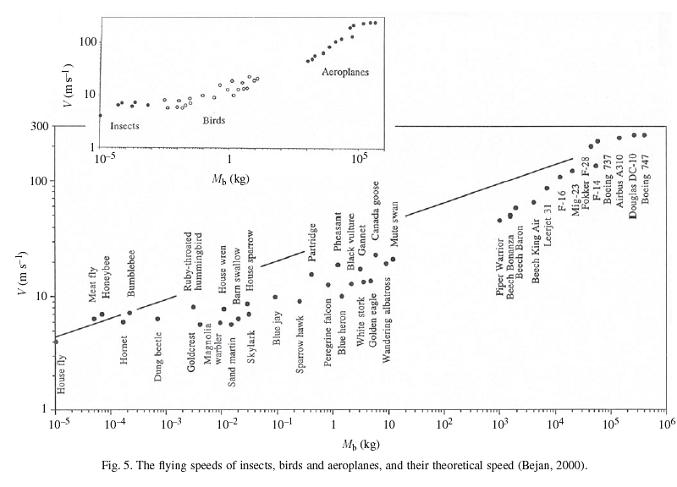
Adrian Bejan, a noted heat transfer researcher, believes that he has found laws that would explain locomotion on the ground, in the air and in water. This is pretty significant since it does not seem obvious on how to connect swimming behavior to walking on the ground. Most of his argument revolves around what he calls constructal theory which as far as I understand says that nature allows for different shapes to occur as a result of optimizing heat transfer at different scales. That results allows for a clear explanation of tree like structures for the lungs, veins, trees, roots which has mostly being looked at as being an ad-hoc assumption. This is a also a result that explains why Nature is not made of fractals. In 2000, he showed you could draw a line through meat flies on 747s on the same graph (the x-axis is the mass, the y-axis is their theoretical speed). This time he shows how, given gravity, density of the body, air and water he can fit pretty much all living things in log-log straight lines.


This is very interesting on many levels. Obviously, our brain says it OK when we see shapes that follow these principles:

  • In the MEMS world, gravity becomes less important compared to Van der Waals forces. Why should normal shapes found at the human scale world be found at these microscales ?


  • On other planets, such as Europa, where there is an expectation of prospects of life, how does different gravity levels (1/6th of a g) changes the shapes of the living bodies there ? Similarly, while most current spacecrafts look like airplanes or cylinders (rocket parts), is there an optimum shaping mechanism in zero-g, how will future spacecrafts built in space look like ?

  • Can we make out the muscle structure of dinosaurs from these types of consideration ? and what is the largest animal we could ever find when digging since every year, there is an announcement of finding larger and larger prehistoric animals ?
  • Friday, May 27, 2005

    What is the plague's ping ?

    If bacteriums use propellers to move around, wouldn't it be likely that we can detect them (and even differentiate them from each other) by listening to noise induced by the propellers like we do for submarines ?

    Printfriendly