SlideShare a Scribd company logo
Copyright © Joe Gollner 2014
Content Strategy,
Technology, Engineering,
Management & Solutions
(STEMS)
@joegollner
Content STEMS: A Practical Introduction
Workshop Objectives
Provide grounded definitions
for the terminology used
when discussing:
• Content Strategy
• Content Technology
• Content Engineering
• Content Management
• Content Solutions
Provide an integrated
framework that connects
these definitions into a
coherent whole that can be used
to organize discussions & projects
Intended Audience
Technical Communicators
People with many new terms, tools & techniques swirling around them
Content Strategists & Solution Providers
People who are creating & swirling the new terms, tools & techniques
Tenth Cybernetics Conference (1953)
A Changing World
for Communicators
Core Definitions
Fundamental
building blocks
The Content
Life Cycle
A Structured Approach
to Content Strategy
The Road to
Effective Content Solutions
Workshop Topics
Albert Einstein by Yousef Karsh (1948)
A Changing World for Communicators
Frederick Winslow Taylor – Scientific Management
A Global Economy calls for
Continuous
process improvement
Maximized automation
Dynamically tailored products
Localized delivery & support
Reconfigurable supply chains
This Demands
Standardized parts
Flexible & dynamic assembly
for products, services, information
& therefore content
The Facts of Business Life
The Practice of Management
(1954)
Peter F. Drucker
The Industrial Context
Design & Manufacturing of Products is changing
Driven by flows of digital information
Product Information is an integral part of the product itself
Product information
• Complex & dynamic
• Aggregated from Suppliers
• Shared with Customers
• Evolved by Users
Escalating precision
• Automated processes
• Continuous collection & use
of analytical data
• All product components
tracked & handled using
automation…
Extreme Localization
Product localization is taken to its logical conclusion
Products need to be completely localized
• Hardware
• Software
• Services & support
Increases configuration complexities
Increases rate of design change
Product information
localization reflects
Language differences
Market differences
Cultural differences
Legal differences
Global Shipping Patterns
Competitive Pressures
Competitive forces are driving down tolerances
Savings and reductions must be found everywhere
• Cycle times
• Transaction costs
• Inventory needs
• Administrative overheads
• Support demands
• Modification expenses
• Legal liabilities
Product information is one
area where savings must be found
Modernization of product information processes is one
mechanism for realizing broad savings & improvements
Fiscal Pressures
The All-Seeing Eye of Financial Management
Nowhere to hide
Insatiable thirst for performance data
Limited taste for innovation
Declining tolerance for risk
Technical Communication
Must be integrated into the
business & product life cycles
Must adopt prevailing patterns
Must provide data metrics
Must be continually optimized
Must work with existing capabilities Charlie Chaplin – Modern Times (1936)
Technical Pressures
Infrastructure rationalization
Standardization of technology environments
Outsourcing of technology development & support
The Technology Environments
used by Communicators
Come under intense scrutiny
• Too specialized for
mainstream resources
• Too different from
mainstream technologies
Run the risk of becoming
orphaned investments
Often seen as a cost & complexity
that should be “externalized”
The business of communication
is changing at an accelerating pace
All these changes are converging
& happening at the same time
Previous tools & techniques of
communication will not suffice
We actually have to consider what
it is we need to actually manage
It’s the Content….
The Birth of Content
(1932)
Content
Information
Publishing
Documents
Related Terms
Back to Basics: Key Definitions
Richard Feynman
Content & Information
Content
Is what we plan, design, create,
reuse & manage so that we can
deliver effective information transactions
Content is potential information
(an asset)
Information
Is the meaningful
organization of data
communicated in a
specific context with the
purpose of influencing others
Information is a transaction (an action)
that contains & delivers Content
Content Components
Text Modules
Media Resources
Data Sources
Relationship Links
Metadata Properties
Concept Taxonomies
Assembly Maps
Governing Models
Validation Criteria
Processing Rules
Distribution Rights
Formatting Instructions
Authority Precedents
This is the implication of the phrase
“potential information”
An information transaction is composed
of numerous content components
coming together to create an effective
information experience
Content & Information: In Practical Terms
Contentus / Contenta / Contentum:
that which is assembled & contained
Ingredients
Tools
Procedures
Packaging
Presentation
The Definition of Content
Web Content
The content delivered to the web
Component Content
Modular & reusable content
Intelligent Content
Portable & Processable
Adaptive Content
Retains intelligence
when published so as
to be responsive to
devices & user needs
Content – properly considered – covers them all
Variations on the term Content
Publishing
The process of transforming
content assets into information products
that can be effectively transacted.
From “to make public”.
Documents
Documents are the persistent form of
information transactions that are
exchanged as part of a business event.
Documents are a fact of life. They provide
evidence of decisions, processes & events.
Documents can take many forms.
Publishing & Documents
Information Disciplines
Seattle Engineering Plan Vault (1936)
Information Technology
Tools for moving, processing & tracking information transactions
Information Security
Protecting information transactions
Information Management
Governance & Accountability
Information eDiscovery
Meeting court requirements
Information Architecture
Frameworks for discovery
Information Experience
Ensuring effective usability
Note: These disciplines only
consider the content indirectly
& only in its published form
Content is defined as “potential information”
- as what we manage in order to deliver effective
information transactions
Information is a transaction that delivers content
to a specific audience in a specific form in order to
influence (inform) its behaviour
These definitions make a very fine distinction between
content & information.
This distinction is important because it makes
management & sustainable improvement possible
– first for content & then for information
Review: Core Definitions
Background
Regulatory Agency for the
Energy Sector managing:
• Regulations
• Process Documentation
• Submissions
• Public Consultation Outcomes
• Judgments
Pressures:
• Growing volume & complexity of regulations & submissions
• Growing complexity of the consultation process
• To bring costs under control or even reduce them
• Maintain or even shorten the process cycle times
Case Study: Regulatory Structured Content
Three Key Ingredients
Top Tier Management Consulting Firm
• Conducted a comprehensive process review
• Collaborated with stakeholders to re-envision the future
Content Management Consulting Firm
• Facilitated a wide-ranging analysis & modeling activity
• Developed target content models with rich semantics
Content Management & Publishing Technology Vendors
• Engaged to tailor their tools to support
• The re-envisioned business process
• Fully-customized content authoring environments
• Sophisticated shared management & publishing services
Case Study: Regulatory Structured Content



What Happened? Complete Disaster! But why?
The Content Life Cycle
Norbert Wiener Lecturing on
Cybernetics (the Science of Communication and Control)
Needed a Model that would
Align with the fundamental definition
of content as potential information
Provide a prominent & practical
position for the ascendant
practice of “Content Strategy”
Properly situates the historically
prominent practice of “Content Management”
Provides a prominent position for “Content Engagement”
to reflect the rise of social media, user generated content,
user analytics, and linked open data sharing
The Content Life Cycle
Norbert Wiener
Content Life Cycle: Core Activities
Content
Acquisition
Content
Management
Content
Delivery
Content
Engagement
How we acquire the content assets
that we need to deliver the
necessary information transactions
Content Acquisition encompasses
Designing content
Creating content
Converting content
from legacy sources
Licensing content
from third parties
Content Acquisition
Content
Acquisition
Key Focus Points:
- Maximize quality
- Minimize costs
- Support authors
- Streamline conversion
- Formalize & optimize
supplier channels
Content Delivery
Assembles then
Publishes
content to deliver information products
that can be effectively transacted
Starts from information needs and
works backward to expedite the
delivery of the necessary renditions
Content Delivery
Content
Delivery
Key Focus Points:
- Satisfy user needs
- Enhance the confidence of users
- Exploit the capabilities of available technology
- Contain costs & complexity
Content Engagement
Content
Engagement
Content Engagement
Tapping into user experiences
Soliciting user feedback
Incorporating user contributions
Leveraging user analytics
Measuring user effectiveness
Facilitating user collaboration
Sharing content with others
Key Focus Points:
- Establish a vital link between the content & its users
- Encourage & facilitate user contributions
- Monitor user activity to see how content is being used
- Drive content evolution with user feedback
- Push feedback to Product Management
Content Management
Content
Management
Content Management
Protecting content value
• Security
• Recovery / Roll-back
Facilitating Reuse
• Discovery (what can be reused)
• Reference (designating reuse)
• Reporting (monitoring reuse)
Facilitating content workflows
• Editorial
• Production
Managing links to dynamic data sources
Reporting on content
& content processes
Key Focus Points:
- Control access
- Facilitate reuse
- Formalize processes
- Facilitate change
- content
- processes
- users
Best Practice: Maintaining Life Cycle Balance
Content
Acquisition
Content
Management
Content
Delivery
Content
Engagement
Over-emphasis on any one area can be a problem
Introducing Content Strategy
A strategy is a plan of
action directed towards
achieving a long-term goal
through the coordination,
integration and application
of the resources and
capabilities available to
an enterprise
Key Points
- It is a plan of action
- Seeks to achieve a long-term business goal
- Leverages available resources & capabilities
Content
Acquisition
Content
Management
Content
Delivery
Content
Engagement
Content
Strategy
Content Strategy
A Content Strategy seeks to make content a strategic
asset that can be leveraged by state-of-the-art
technology to achieve concrete business goals.
Critically, it will determine
what content is needed and it will explain why.
It will justify the investments that need to be made.
The Tao of Content Strategy
Introducing a Measurement Framework
Content
Delivery
Content
Acquisition
Content
Management
Content
Engagement
1
10
1
1 1
10
1010
For a Content Strategy to be a genuine plan of action,
it must deploy measurement in order to target & monitor investments.
Content Metrics reflect the measurements that an organization
deems important. The first step is determining what needs to be measured.
Content
Delivery
Content
Acquisition
Content
Management
Content
Engagement
2.4
4.2
As Is
2.8
4.0
8.3
8.77.8
To Be
1
10
1
1 1
10
1010
8.8
Content Metrics
“As Is” Current Score: 45 “To Be” Target Score: 281
Content Strategy: Example Evaluation Framework
Evaluation Criteria
Competitiveness
Consistency
Responsiveness
Maintainability
Measurability
Usability
What is being Evaluated
Benchmark comparisons against comparable organizations
The consistency of content details across the collection (measure of reuse)
The extent to which new demands can be met quickly & affordably
Maintainability & supportability of the overall solution
Completeness & quality of the measurement data provided
Efficiency & intuitiveness of all user interactions (supporting user success)
Score Assigned
0 – No Score
2 – Poor
4 – Weak
6 – Fair
8 – Good
10 – Excellent
Optional Weighting Scheme
Applied to Evaluation Criteria
0.5 – Less important
1.5 – More important
Every criterion weighted as
more important must be
balanced by one that is rated as
less important
Capability Level
None
Minimal
Inadequate
Adequate
Competitive
Industry Leading
Evaluation Method
Scoring Method
Scores are assigned to each
criteria for each quadrant &
averaged. The area of the polygon
that results is the total score.
CDQuadrantCMQuadrant
CEQuadrantCAQuadrant
Content
Delivery
Content
Acquisition
Content
Management
Content
Engagement
P1
P2
P3
2.4
4.2
As Is
2.8
4.0
8.3
8.77.8
To Be
1
10
1
1 1
10
1010
8.8
P1: Phase 1 P2: Phase 2 P3: Phase 3
Content Strategy: Planning Summary Worksheet
CA
CD
CM
CE
ImprovementPhase 1: Demonstration Capability
Budget: CA
CD
CM
CE
Phase 1 ScorePhase 1
CA
CD
CM
CE
As Is ScoreCurrent State: Key Shortcomings
CA
CD
CM
CE
ImprovementPhase 2: Working Capability
CA
CD
CM
CE
Phase 2 ScorePhase 2
CA
CD
CM
CE
ImprovementPhase 3: Production Capability
CA
CD
CM
CE
Target ScorePhase 3
Business Priorities
User Priorities
System Priorities
Content Strategy: Planning Summary Worksheet
A summary of planning details that can be used to distill key ideas
and details. The discipline of identifying principle objectives in
each phase, and matching these to schedule and budget
boundaries, can be a very effective way to focus project activities.
Schedule:
Budget:
Schedule:
Budget:
Schedule:
The Demonstration Phase of a project should
focus efforts on delivering business capabilities
that will engage executive stakeholders who will
have the authority to support & sustain the full
range of investments that will be required.
The Working Phase of a
project should focus on
enhancing the productivity
of all users within a
redesigned content process.
The Production Phase of a project should focus on
establishing a cost-effective, sustainable and
scalable environment that makes the most of open
standards and adaptable technologies.
Content AcquisitionCA Content DeliveryCD Content ManagementCM Content EngagementCE
+
+
+
The key innovation to be
implemented during each phase
and in each quadrant
(CA, CD, CM, CE)
should be identified briefly
(e.g., Browser-based editing for CA)
Total Budget
Total Schedule:
Migration to Structured Authoring Tool CA 1.6
CD 2.0
CM 1.4
CE 1.3
ImprovementPhase 1: Demonstration Capability
Budget:
$85,000
CA 7.3
CD 4.8
CM 3.9
CE 5.3
Phase 1 ScorePhase 1
New Web based online deliverable
Introduce standardized metadata & workflow
Provide online feedback & discussion capability
Proprietary Authoring Tool with moderate discipline CA 5.7
CD 2.8
CM 2.5
CE 4.0
As Is ScoreCurrent State: Key Shortcomings
PDF Deliverables provided online
Custom In-house Management Database
Customers provide feedback using PDF comments
Introduce Refined Reuse Practices CA 0.9
CD 2.2
CM 1.1
CE 1.5
ImprovementPhase 2: Working Capability
CA 8.2
CD 7.0
CM 5.0
CE 6.8
Phase 2 ScorePhase 2
Provide dynamic tailoring of content by user type
Introduce enhanced quality assurance processes
Introduce improved analytics & success measures
Provide authoring assistance tools CA O.9
CD 2.0
CM 3.1
CE 1.1
ImprovementPhase 3: Production Capability
CA 9.3
CD 9.0
CM 8.1
CE 7.9
Target ScorePhase 3
Introduce mobile version of deliverables
Introduce new content management system
Introduce user profiles & reputation status
Business Priorities
User Priorities
System Priorities
Content Strategy: Planning Summary Worksheet
A summary of planning details that can be used to distill key ideas
and details. The discipline of identifying principle objectives in
each phase, and matching these to schedule and budget
boundaries, can be a very effective way to focus project activities.
Schedule:
4 months
Budget:
$100,000
Schedule:
4 months
Budget:
$200,000
Schedule:
4 months
The Demonstration Phase of a project should
focus efforts on delivering business capabilities
that will engage executive stakeholders who will
have the authority to support & sustain the full
range of investments that will be required.
The Working Phase of a
project should focus on
enhancing the productivity
of all users within a
redesigned content process.
The Production Phase of a project should focus on
establishing a cost-effective, sustainable and
scalable environment that makes the most of open
standards and adaptable technologies.
+
+
+
The key innovation to be
implemented during each phase
and in each quadrant
(CA, CD, CM, CE)
should be identified briefly
Content AcquisitionCA Content DeliveryCD Content ManagementCM Content EngagementCE
Total Budget
Total Schedule:
$385,000
12 months
Content Strategy: Sample Project Worksheet
Grounded Content Strategy
Content
Delivery
Content
Acquisition
Content
Management
Content
Engagement
1
10
1
1 1
10
1010
Content
Strategy
A grounded Content Strategy is one that identifies concrete & measurable
objectives for balanced investments in the Content Life Cycle.
Content Strategy & the Content Life Cycle
Content
Acquisition
Content
Management
Content
Delivery
Content
Engagement
Content
Strategy
A continuously evolving Content Strategy
will drive a continuously improving Content Life Cycle
which delivers continuously increasing benefits to the enterprise
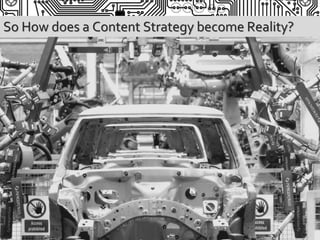
So How does a Content Strategy become Reality?
Content Technology > Engineering > Solutions
Content Technology
Content
Acquisition
Content
Management
Content
Delivery
Content
Engagement
Content
Strategy
Content Engineering
Content Solutions
Content Technology
Technology that has been specifically designed to
create, store, manage & process content with all its complexity
including content that has been optimized for portability &
processability using open standards
Content exhibits highly
complex structures
• Data arrangements (tables)
• Integrated media resources
• Cross-references
• Pattern nesting
• Variable occurrence
• Rhetorical framework &
techniques designed
to guide users
Content Technology
Content Acquisition
Adapting to the actual structures
encountered in content
Facilitating acquisition tasks
Content Acquisition
Content
Acquisition
Authoring tools:
XML Editors /
Augmented Word Processors /
Online Editing Environments
Conversion services:
Full Service Providers / SaaS Options
External sourcing:
Aggregation & validation processes
Content Delivery
Content
Delivery
Print Delivery
Deliver
- Resolve
- Compile
- Publish
Content
Resolve
Publish
Deploy
Digital
Products
Deploy
Printable
Products
XML
XHTML
HTML5
OOXML
PDF / EPS
InDesign
Quark
MS Word
Templates
Output Plan
(Map & View)
Assets
Rules
OutputVariants
Render
Transformations
Compile
Content
Digital Delivery
Content Delivery
Selecting what content to include
Resolving all reuse relationships
Filtering content for each “view”
Compiling content into a form that
can be efficiently rendered
Rendering formatted representations
Deploying delivery packages
Open Source Options:
DITA OT / FOP
Transformation Tools:
Saxon / MSXML / OmniMark
Formatting Tools:
AntennaHouse / RenderX /
FrameMaker / InDesign…
Content Engagement
Content
Engagement
Content Engagement
Numerous options for engaging users
• Wikis
• WCMS facilitating
• Comments
• Rating
• User Tracking
• “Smart” online help
• Dynamic delivery solutions
• Commercial
• Custom
Dynamic Delivery: SDL LiveContent / SuiteShare
Help Publishers: WebWorks / MadCap / RoboHelp
XML Databases: Ixiasoft TextML / MarkLogic / EMC Dynamic Server
Social Media / WCMS: MindTouch, Ingeniux,…
The most complex scenario
arises when content is published
into partner application environments
and usage data & feedback is
harvested from those systems
Content Management
Content
Management
Content Management
Wide-range of implementation options
Numerous commercial offerings
• Different price ranges
• Different storage architectures
• Different levels of product maturity
• Different levels of internal integration
• Different levels of external integration
• Different levels of portability across industries
Key Criteria: Adaptability
CCMSs: Trisoft / Ixiasoft / Bluestream / Componize / Astoria + Vasont / …
Augmented CMSs: DITAExchange with SharePoint / Documentum / …
SaaS Alternatives: EasyDITA / DocZone
Customization of Existing Infrastructure: Common approach but not without problems
Content Engineering
Content Engineering:
The application of engineering discipline to the
design, acquisition, delivery, management, and use
of content and to the technologies
deployed to support the full content life cycle
The Language of Content Strategy
A Definition of Engineering
Engineering:
Engineering is the application of scientific principles to the
design, development, support and use of systems which are
themselves made up of structures and processes.
Engineering entails the
methodical & documented use of
 precedents
 standards
 experiments
 measurements
 tests
 best practices
 past experience
 state-of-the-art
technology
Content Engineering: Building Content Solution
Content
Acquisition
Content
Delivery
Content
Engagement
Content
Management
• Analyze information requirements
• Analyze content sources
• Model content structures & semantics
• Determine validation criteria
• Design information products
• Model content processes
• Implement content processes
• Implement validation processes
• Design information interactions
• Validate usability against user task success
• Design, implement & deploy content engagement platform
• Implement validation processes
• Design & implement management regime
• Design & implement workflows
• Design & implement reporting services
• Design & implement user support services
Content Standards
Defined & maintained by a community with common or shared
interests to facilitate interoperability & better overall results
Prominent Content Standards
Extensible Markup Language (XML)
A very widely used standard for interchangeable data
Darwin Information Typing Architecture (DITA)
A popular protocol for implementing topic-based XML content
XML Stylesheet Language Transformations (XSLT)
Widely used method for transforming XML into other forms
HTML5
Ascendant format for web content with an XML serialization
Focus: Content Standards
Focus: Content Conversion
Interaction
Modify
Conversion
Process
Source
Analysis
Source to
Target
Mapping
Subject
Matter
Experts
Execute
Conversion
Process
Result
Analysis
Identified
Issues
Validation &
Verification
Application
Tests
Interaction
Legacy
Source
Content
Modified
Conversion
Rules
Example
Set
Sample
Set 10%
Complete
Set 100%
1
2
3
Target
XML
Schema
Manual
Editing
Guidance
Complete
Existing
Conversion
Rules
There is no magic but organizations typically underestimate how well this can be done
Taxonomy
metadata
metadata
Link Network
Ontology
Topic
Topic
Topic
Topic
Focus: Ontologies, Taxonomies & Metadata
The Meaning of Metadata
Metadata categories and values
relate content to aspects of
an Ontology
The Ontology provides the
context for metadata
Ontologies
Describe a domain of knowledge
Can be used as the basis of:
• Taxonomies (classification schemes)
• Composition Trees (part-ologies)
• Link networks
• Context driven navigational aids
Focus: Link Management
Increasingly
important
Increasingly
complex
Link Analysis
Demands
significant
processing
Often a point
of solution
weakness
Link generation
becoming a more common tactic
metadata
metadata
Outbound Link
Transclusion Link
Inbound Link
Link Base
Bidirectional
External Link
Link Analysis:
Outbound Links: Intact or broken
Transclusions: Where used
Inbound Links: Track-back / Where cited
External Links: Network participation
Focus: Validation & Transformation
Content Validation & Verification
Schema structural rules
Rules governing content values
Establishing conformance
Content Transformation
Continuous process of improvement
Parse, validate, align, verify…repeat
Manipulation of many content types
Validated Outputs
Inputs to rendition processes
HTML outputs & XML outputs
Data outputs for applications
Transformation
Processing
Outputs
Content
Instance
Schema


Rules
Structure Validation


Content Verification


 
Content Engineering
marshals the capabilities
of the available
Content Technologies
to realize a
Content Solution
that delivers tangible
business results
Content Solution
support the efficient operation of the
Content Life Cycle & its ongoing evolution
Content Solutions
Technology
Knowledge
Business
Content
Solutions
Content
M
anagement
Knowledge
Management
Business
Systems
Documented & Integrated
Global&Dynamic
Open&Extensible
2002 – Initiative to Digitize Drug Information Products
Case Study: Pharmaceutical Portal
Single Source
of dynamically
published content
Online information about medications proved to be
much more useful than the older printed reference
books. Publishing revenues increased. Content
timeliness improved.
Highly successful project
Rapid development of prototype allowed
• The opportunity to be validated with customer community
• New requirements to be refined & incorporated into portal
Content conversion challenges overcome
• Initial strategies introduced to provide “good enough” results
• Long-term strategies designed for more advanced results
Emphasis placed on delivering a new capability & engaging users
Key Success Indicators
Same solution in use more than 10 years later
Same solution supported addition of a new mobile channel
Challenges: Customer was drawn into several expensive
rounds of investment in inflexible CMSs…
Case Study: Pharmaceutical Portal
Data > Information > Knowledge > Content?
How does content fit in?
Data
The meaningful
representation
of experience.
The building blocks
of communication.
Knowledge
The meaningful organization of information
expressing an evolving understanding of a subject
and establishing the justified basis for judgement
and therefore the potential for effective action
Information
Data
Knowledge
Content
Substantiated Information Content is the most valuable
asset an enterprise has – it is Liquid Knowledge
Content Solutions
ultimately impact high-level
business operations
Customer experience
Customer-driven Product Management
Supply chain integration
Business Process Management
• Lean manufacturing & Six Sigma
Innovation Management
• Intellectual Property Management
• Cross-enterprise collaboration
This is not what most Technical Communicators see
themselves doing but this is where the future lies…
The Importance of Content Solutions
The world in which
communicators work
is changing rapidly
These changes are forcing
organizations to revamp
how they design, process
& manage their content
Leveraging open standards
& automation in order to
integrate content, and content
processes into the business landscape
These changes cannot be avoided but they
can be positive if embraced & leveraged…
Summary
Alan Turing
& Colossus
Making Connections
Joe Gollner
Gnostyx Research Inc.
www.gnostyx.com
jag@gnostyx.com
Twitter: @joegollner
Blog:
The Content Philosopher
www.gollner.ca

More Related Content

PPT
Technology strategy & development
PPTX
Technology Exports, Forecasting & Global Trends in Technology Management
PPTX
Approaches to technology strategy
PPS
Technology strategy
DOCX
Project planning and analysis
PPT
Technology management
PPT
technology diffusion
PPT
Technology management
Technology strategy & development
Technology Exports, Forecasting & Global Trends in Technology Management
Approaches to technology strategy
Technology strategy
Project planning and analysis
Technology management
technology diffusion
Technology management

What's hot (20)

PPTX
Technology acquisition & absorption
PPT
Technology forecasting
PPTX
INTEGRATION OF PEOPLE AND TECHNOLOGY
PPTX
Technology Management
PPTX
Wk 2 role of technology
PPTX
Wk 3 critical factors in managing technology
PPT
Technology transfer & acquisition
PPT
Technology+forecasting
PPT
Sanjaya lall
PPT
Technology absorption & diffusion
PPTX
Wk 4 technology life cycle
PPT
Technology intelliegence & forecasting
PPT
Technology absorption and acquisition
PPTX
Introduction to Management of Technology
PPTX
APPROACHES TO TECHNOLOGY STRATEGY
PPT
Ppt on technology mgmt
PPT
Technology Management Chapter 1 Notes
PPT
Technology life cycle
PPT
Technology management
Technology acquisition & absorption
Technology forecasting
INTEGRATION OF PEOPLE AND TECHNOLOGY
Technology Management
Wk 2 role of technology
Wk 3 critical factors in managing technology
Technology transfer & acquisition
Technology+forecasting
Sanjaya lall
Technology absorption & diffusion
Wk 4 technology life cycle
Technology intelliegence & forecasting
Technology absorption and acquisition
Introduction to Management of Technology
APPROACHES TO TECHNOLOGY STRATEGY
Ppt on technology mgmt
Technology Management Chapter 1 Notes
Technology life cycle
Technology management
Ad

Viewers also liked (20)

PDF
Transforming Companies Through Value Creation not Value Destruction
PDF
How Young Companies Can Grow Faster, Smarter - Daniel Saks, AppDirect
PPTX
Boston Startup Scene Guide - Fall 2013
PDF
Jumping to Light Speed (Spotlight Session at STC 2014)
PDF
Integrated Content Management - Information Energy 2015 Keynote
PDF
Managing Software as Knowledge (2005)
PDF
DITA - What is it good for? (J Gollner 2015)
PDF
Brief History of Content (J Gollner 2014)
PDF
Content 4.0
PDF
Are You Ready for Content 4 0?
PDF
The Dark Arts of Content Leadership
PDF
The Changing Face of Publishing (October 2012)
PDF
Managing DITA (Nov 2015)
PDF
The Emergence of Intelligent Content (Revised)
PDF
Content Leadership
PDF
Getting a Handle on the Content Life Cycle (April 2014)
PDF
Breaking Bad Content (Lavacon 2013 J Gollner)
PDF
Professional Publishing: Intelligent eBooks for Working Professionals
PDF
Coordinating Markup Projects (CALS Expo 1995)
PDF
The Making of 'The Language of Content Strategy' - by Scott Abel, The Content...
Transforming Companies Through Value Creation not Value Destruction
How Young Companies Can Grow Faster, Smarter - Daniel Saks, AppDirect
Boston Startup Scene Guide - Fall 2013
Jumping to Light Speed (Spotlight Session at STC 2014)
Integrated Content Management - Information Energy 2015 Keynote
Managing Software as Knowledge (2005)
DITA - What is it good for? (J Gollner 2015)
Brief History of Content (J Gollner 2014)
Content 4.0
Are You Ready for Content 4 0?
The Dark Arts of Content Leadership
The Changing Face of Publishing (October 2012)
Managing DITA (Nov 2015)
The Emergence of Intelligent Content (Revised)
Content Leadership
Getting a Handle on the Content Life Cycle (April 2014)
Breaking Bad Content (Lavacon 2013 J Gollner)
Professional Publishing: Intelligent eBooks for Working Professionals
Coordinating Markup Projects (CALS Expo 1995)
The Making of 'The Language of Content Strategy' - by Scott Abel, The Content...
Ad

Similar to Introduction to Content Strategy, Technology, Engineering, Management and Solutions (STEMS) (20)

PDF
Getting it Right: Building Quality into your Content (July 2014)
PDF
Implementing Intelligent Content Solutions (Joe Gollner - Intelligent Content...
PDF
Digital Transformation and DITA
PPTX
UNESCO IFLA ICA Digital Preservation Roadmap
PDF
ITIL4 Guide to practices - review materials
PDF
Consultation Objectives
PPTX
Knowledge Management for Technology Transfer Organizations: A Key to Sustaina...
PDF
Adaptive Business Capability
PPT
Starting a Digital Preservation Program
PDF
week 5.pdfbusiness acumen and strategy development
PPT
The role of the central IT Services organisation in a Web 2.0 world
PDF
So You Want a CMS (Gnostyx Workshop Lavacon 2016)
PPT
Symposium 2010 Gnaedinger Managing (And Leveraging) Information) (3)
PPTX
Introductory of Information Technology
PDF
Information 4.0 for Industry 4.0 (TCWorld 2016)
PDF
Operations and supply chain management for managers
PDF
Intelligent Compliance to Optimize Energy Sector Enterprise Content Managemen...
PDF
Flex mode framework architectural overview v 2.1 19-08-2013
PPT
Content management
Getting it Right: Building Quality into your Content (July 2014)
Implementing Intelligent Content Solutions (Joe Gollner - Intelligent Content...
Digital Transformation and DITA
UNESCO IFLA ICA Digital Preservation Roadmap
ITIL4 Guide to practices - review materials
Consultation Objectives
Knowledge Management for Technology Transfer Organizations: A Key to Sustaina...
Adaptive Business Capability
Starting a Digital Preservation Program
week 5.pdfbusiness acumen and strategy development
The role of the central IT Services organisation in a Web 2.0 world
So You Want a CMS (Gnostyx Workshop Lavacon 2016)
Symposium 2010 Gnaedinger Managing (And Leveraging) Information) (3)
Introductory of Information Technology
Information 4.0 for Industry 4.0 (TCWorld 2016)
Operations and supply chain management for managers
Intelligent Compliance to Optimize Energy Sector Enterprise Content Managemen...
Flex mode framework architectural overview v 2.1 19-08-2013
Content management

More from Joe Gollner (13)

PPTX
A Content Manifesto (Gnostyx CIDM IDEAS Conference 2020)
PDF
The Economics of Content (October 2019)
PDF
Managing Knowledge in the Fractal Enterprise (Retro Alert 1999)
PDF
Engineering Content: The Discipline of Designing Future-Ready Content
PDF
Brave New World of Technical Communication
PDF
Digital Transformation and the Business of Content (May 2017)
PDF
Three Projects One Lesson (April 2017)
PDF
CALS and Canadian Government Acquisition 1994
PDF
Practical Steps Towards Integrated Content Management (Nov 2015)
PDF
Defining Intelligent Content (J Gollner Mar 2015)
PDF
Lean Manufacturing and DITA (Gnostyx at DITA Europe 2014)
PDF
Secrets to Content Initiative Success (Gollner Lavacon 2014)
PDF
Content Solution Quick Start (June 2014)
A Content Manifesto (Gnostyx CIDM IDEAS Conference 2020)
The Economics of Content (October 2019)
Managing Knowledge in the Fractal Enterprise (Retro Alert 1999)
Engineering Content: The Discipline of Designing Future-Ready Content
Brave New World of Technical Communication
Digital Transformation and the Business of Content (May 2017)
Three Projects One Lesson (April 2017)
CALS and Canadian Government Acquisition 1994
Practical Steps Towards Integrated Content Management (Nov 2015)
Defining Intelligent Content (J Gollner Mar 2015)
Lean Manufacturing and DITA (Gnostyx at DITA Europe 2014)
Secrets to Content Initiative Success (Gollner Lavacon 2014)
Content Solution Quick Start (June 2014)

Recently uploaded (20)

PDF
simpleintnettestmetiaerl for the simple testint
PDF
Uptota Investor Deck - Where Africa Meets Blockchain
PDF
Session 1 (Week 1)fghjmgfdsfgthyjkhfdsadfghjkhgfdsa
PPT
250152213-Excitation-SystemWERRT (1).ppt
PPTX
Slides PPTX: World Game (s): Eco Economic Epochs.pptx
PDF
📍 LABUAN4D EXCLUSIVE SERVER STAR GAMING ASIA NO.1 TERPOPULER DI INDONESIA ! 🌟
PPTX
E -tech empowerment technologies PowerPoint
PPT
415456121-Jiwratrwecdtwfdsfwgdwedvwe dbwsdjsadca-EVN.ppt
PPTX
Layers_of_the_Earth_Grade7.pptx class by
PDF
Slides PDF: The World Game (s) Eco Economic Epochs.pdf
PDF
Exploring VPS Hosting Trends for SMBs in 2025
PPTX
Mathew Digital SEO Checklist Guidlines 2025
PDF
Smart Home Technology for Health Monitoring (www.kiu.ac.ug)
PPTX
Introduction to cybersecurity and digital nettiquette
PPTX
Database Information System - Management Information System
PDF
📍 LABUAN4D EXCLUSIVE SERVER STAR GAMING ASIA NO.1 TERPOPULER DI INDONESIA ! 🌟
PDF
The New Creative Director: How AI Tools for Social Media Content Creation Are...
PPTX
Funds Management Learning Material for Beg
PPT
FIRE PREVENTION AND CONTROL PLAN- LUS.FM.MQ.OM.UTM.PLN.00014.ppt
PDF
The Evolution of Traditional to New Media .pdf
simpleintnettestmetiaerl for the simple testint
Uptota Investor Deck - Where Africa Meets Blockchain
Session 1 (Week 1)fghjmgfdsfgthyjkhfdsadfghjkhgfdsa
250152213-Excitation-SystemWERRT (1).ppt
Slides PPTX: World Game (s): Eco Economic Epochs.pptx
📍 LABUAN4D EXCLUSIVE SERVER STAR GAMING ASIA NO.1 TERPOPULER DI INDONESIA ! 🌟
E -tech empowerment technologies PowerPoint
415456121-Jiwratrwecdtwfdsfwgdwedvwe dbwsdjsadca-EVN.ppt
Layers_of_the_Earth_Grade7.pptx class by
Slides PDF: The World Game (s) Eco Economic Epochs.pdf
Exploring VPS Hosting Trends for SMBs in 2025
Mathew Digital SEO Checklist Guidlines 2025
Smart Home Technology for Health Monitoring (www.kiu.ac.ug)
Introduction to cybersecurity and digital nettiquette
Database Information System - Management Information System
📍 LABUAN4D EXCLUSIVE SERVER STAR GAMING ASIA NO.1 TERPOPULER DI INDONESIA ! 🌟
The New Creative Director: How AI Tools for Social Media Content Creation Are...
Funds Management Learning Material for Beg
FIRE PREVENTION AND CONTROL PLAN- LUS.FM.MQ.OM.UTM.PLN.00014.ppt
The Evolution of Traditional to New Media .pdf

Introduction to Content Strategy, Technology, Engineering, Management and Solutions (STEMS)

  • 1. Copyright © Joe Gollner 2014 Content Strategy, Technology, Engineering, Management & Solutions (STEMS) @joegollner
  • 2. Content STEMS: A Practical Introduction Workshop Objectives Provide grounded definitions for the terminology used when discussing: • Content Strategy • Content Technology • Content Engineering • Content Management • Content Solutions Provide an integrated framework that connects these definitions into a coherent whole that can be used to organize discussions & projects
  • 3. Intended Audience Technical Communicators People with many new terms, tools & techniques swirling around them Content Strategists & Solution Providers People who are creating & swirling the new terms, tools & techniques Tenth Cybernetics Conference (1953)
  • 4. A Changing World for Communicators Core Definitions Fundamental building blocks The Content Life Cycle A Structured Approach to Content Strategy The Road to Effective Content Solutions Workshop Topics Albert Einstein by Yousef Karsh (1948)
  • 5. A Changing World for Communicators Frederick Winslow Taylor – Scientific Management
  • 6. A Global Economy calls for Continuous process improvement Maximized automation Dynamically tailored products Localized delivery & support Reconfigurable supply chains This Demands Standardized parts Flexible & dynamic assembly for products, services, information & therefore content The Facts of Business Life The Practice of Management (1954) Peter F. Drucker
  • 7. The Industrial Context Design & Manufacturing of Products is changing Driven by flows of digital information Product Information is an integral part of the product itself Product information • Complex & dynamic • Aggregated from Suppliers • Shared with Customers • Evolved by Users Escalating precision • Automated processes • Continuous collection & use of analytical data • All product components tracked & handled using automation…
  • 8. Extreme Localization Product localization is taken to its logical conclusion Products need to be completely localized • Hardware • Software • Services & support Increases configuration complexities Increases rate of design change Product information localization reflects Language differences Market differences Cultural differences Legal differences Global Shipping Patterns
  • 9. Competitive Pressures Competitive forces are driving down tolerances Savings and reductions must be found everywhere • Cycle times • Transaction costs • Inventory needs • Administrative overheads • Support demands • Modification expenses • Legal liabilities Product information is one area where savings must be found Modernization of product information processes is one mechanism for realizing broad savings & improvements
  • 10. Fiscal Pressures The All-Seeing Eye of Financial Management Nowhere to hide Insatiable thirst for performance data Limited taste for innovation Declining tolerance for risk Technical Communication Must be integrated into the business & product life cycles Must adopt prevailing patterns Must provide data metrics Must be continually optimized Must work with existing capabilities Charlie Chaplin – Modern Times (1936)
  • 11. Technical Pressures Infrastructure rationalization Standardization of technology environments Outsourcing of technology development & support The Technology Environments used by Communicators Come under intense scrutiny • Too specialized for mainstream resources • Too different from mainstream technologies Run the risk of becoming orphaned investments Often seen as a cost & complexity that should be “externalized”
  • 12. The business of communication is changing at an accelerating pace All these changes are converging & happening at the same time Previous tools & techniques of communication will not suffice We actually have to consider what it is we need to actually manage It’s the Content…. The Birth of Content (1932)
  • 13. Content Information Publishing Documents Related Terms Back to Basics: Key Definitions Richard Feynman
  • 14. Content & Information Content Is what we plan, design, create, reuse & manage so that we can deliver effective information transactions Content is potential information (an asset) Information Is the meaningful organization of data communicated in a specific context with the purpose of influencing others Information is a transaction (an action) that contains & delivers Content
  • 15. Content Components Text Modules Media Resources Data Sources Relationship Links Metadata Properties Concept Taxonomies Assembly Maps Governing Models Validation Criteria Processing Rules Distribution Rights Formatting Instructions Authority Precedents This is the implication of the phrase “potential information” An information transaction is composed of numerous content components coming together to create an effective information experience Content & Information: In Practical Terms
  • 16. Contentus / Contenta / Contentum: that which is assembled & contained Ingredients Tools Procedures Packaging Presentation The Definition of Content
  • 17. Web Content The content delivered to the web Component Content Modular & reusable content Intelligent Content Portable & Processable Adaptive Content Retains intelligence when published so as to be responsive to devices & user needs Content – properly considered – covers them all Variations on the term Content
  • 18. Publishing The process of transforming content assets into information products that can be effectively transacted. From “to make public”. Documents Documents are the persistent form of information transactions that are exchanged as part of a business event. Documents are a fact of life. They provide evidence of decisions, processes & events. Documents can take many forms. Publishing & Documents
  • 19. Information Disciplines Seattle Engineering Plan Vault (1936) Information Technology Tools for moving, processing & tracking information transactions Information Security Protecting information transactions Information Management Governance & Accountability Information eDiscovery Meeting court requirements Information Architecture Frameworks for discovery Information Experience Ensuring effective usability Note: These disciplines only consider the content indirectly & only in its published form
  • 20. Content is defined as “potential information” - as what we manage in order to deliver effective information transactions Information is a transaction that delivers content to a specific audience in a specific form in order to influence (inform) its behaviour These definitions make a very fine distinction between content & information. This distinction is important because it makes management & sustainable improvement possible – first for content & then for information Review: Core Definitions
  • 21. Background Regulatory Agency for the Energy Sector managing: • Regulations • Process Documentation • Submissions • Public Consultation Outcomes • Judgments Pressures: • Growing volume & complexity of regulations & submissions • Growing complexity of the consultation process • To bring costs under control or even reduce them • Maintain or even shorten the process cycle times Case Study: Regulatory Structured Content
  • 22. Three Key Ingredients Top Tier Management Consulting Firm • Conducted a comprehensive process review • Collaborated with stakeholders to re-envision the future Content Management Consulting Firm • Facilitated a wide-ranging analysis & modeling activity • Developed target content models with rich semantics Content Management & Publishing Technology Vendors • Engaged to tailor their tools to support • The re-envisioned business process • Fully-customized content authoring environments • Sophisticated shared management & publishing services Case Study: Regulatory Structured Content    What Happened? Complete Disaster! But why?
  • 23. The Content Life Cycle Norbert Wiener Lecturing on Cybernetics (the Science of Communication and Control)
  • 24. Needed a Model that would Align with the fundamental definition of content as potential information Provide a prominent & practical position for the ascendant practice of “Content Strategy” Properly situates the historically prominent practice of “Content Management” Provides a prominent position for “Content Engagement” to reflect the rise of social media, user generated content, user analytics, and linked open data sharing The Content Life Cycle Norbert Wiener
  • 25. Content Life Cycle: Core Activities Content Acquisition Content Management Content Delivery Content Engagement
  • 26. How we acquire the content assets that we need to deliver the necessary information transactions Content Acquisition encompasses Designing content Creating content Converting content from legacy sources Licensing content from third parties Content Acquisition Content Acquisition Key Focus Points: - Maximize quality - Minimize costs - Support authors - Streamline conversion - Formalize & optimize supplier channels
  • 27. Content Delivery Assembles then Publishes content to deliver information products that can be effectively transacted Starts from information needs and works backward to expedite the delivery of the necessary renditions Content Delivery Content Delivery Key Focus Points: - Satisfy user needs - Enhance the confidence of users - Exploit the capabilities of available technology - Contain costs & complexity
  • 28. Content Engagement Content Engagement Content Engagement Tapping into user experiences Soliciting user feedback Incorporating user contributions Leveraging user analytics Measuring user effectiveness Facilitating user collaboration Sharing content with others Key Focus Points: - Establish a vital link between the content & its users - Encourage & facilitate user contributions - Monitor user activity to see how content is being used - Drive content evolution with user feedback - Push feedback to Product Management
  • 29. Content Management Content Management Content Management Protecting content value • Security • Recovery / Roll-back Facilitating Reuse • Discovery (what can be reused) • Reference (designating reuse) • Reporting (monitoring reuse) Facilitating content workflows • Editorial • Production Managing links to dynamic data sources Reporting on content & content processes Key Focus Points: - Control access - Facilitate reuse - Formalize processes - Facilitate change - content - processes - users
  • 30. Best Practice: Maintaining Life Cycle Balance Content Acquisition Content Management Content Delivery Content Engagement Over-emphasis on any one area can be a problem
  • 32. A strategy is a plan of action directed towards achieving a long-term goal through the coordination, integration and application of the resources and capabilities available to an enterprise Key Points - It is a plan of action - Seeks to achieve a long-term business goal - Leverages available resources & capabilities Content Acquisition Content Management Content Delivery Content Engagement Content Strategy Content Strategy
  • 33. A Content Strategy seeks to make content a strategic asset that can be leveraged by state-of-the-art technology to achieve concrete business goals. Critically, it will determine what content is needed and it will explain why. It will justify the investments that need to be made. The Tao of Content Strategy
  • 34. Introducing a Measurement Framework Content Delivery Content Acquisition Content Management Content Engagement 1 10 1 1 1 10 1010 For a Content Strategy to be a genuine plan of action, it must deploy measurement in order to target & monitor investments.
  • 35. Content Metrics reflect the measurements that an organization deems important. The first step is determining what needs to be measured. Content Delivery Content Acquisition Content Management Content Engagement 2.4 4.2 As Is 2.8 4.0 8.3 8.77.8 To Be 1 10 1 1 1 10 1010 8.8 Content Metrics “As Is” Current Score: 45 “To Be” Target Score: 281
  • 36. Content Strategy: Example Evaluation Framework Evaluation Criteria Competitiveness Consistency Responsiveness Maintainability Measurability Usability What is being Evaluated Benchmark comparisons against comparable organizations The consistency of content details across the collection (measure of reuse) The extent to which new demands can be met quickly & affordably Maintainability & supportability of the overall solution Completeness & quality of the measurement data provided Efficiency & intuitiveness of all user interactions (supporting user success) Score Assigned 0 – No Score 2 – Poor 4 – Weak 6 – Fair 8 – Good 10 – Excellent Optional Weighting Scheme Applied to Evaluation Criteria 0.5 – Less important 1.5 – More important Every criterion weighted as more important must be balanced by one that is rated as less important Capability Level None Minimal Inadequate Adequate Competitive Industry Leading Evaluation Method Scoring Method Scores are assigned to each criteria for each quadrant & averaged. The area of the polygon that results is the total score. CDQuadrantCMQuadrant CEQuadrantCAQuadrant Content Delivery Content Acquisition Content Management Content Engagement P1 P2 P3 2.4 4.2 As Is 2.8 4.0 8.3 8.77.8 To Be 1 10 1 1 1 10 1010 8.8 P1: Phase 1 P2: Phase 2 P3: Phase 3
  • 37. Content Strategy: Planning Summary Worksheet CA CD CM CE ImprovementPhase 1: Demonstration Capability Budget: CA CD CM CE Phase 1 ScorePhase 1 CA CD CM CE As Is ScoreCurrent State: Key Shortcomings CA CD CM CE ImprovementPhase 2: Working Capability CA CD CM CE Phase 2 ScorePhase 2 CA CD CM CE ImprovementPhase 3: Production Capability CA CD CM CE Target ScorePhase 3 Business Priorities User Priorities System Priorities Content Strategy: Planning Summary Worksheet A summary of planning details that can be used to distill key ideas and details. The discipline of identifying principle objectives in each phase, and matching these to schedule and budget boundaries, can be a very effective way to focus project activities. Schedule: Budget: Schedule: Budget: Schedule: The Demonstration Phase of a project should focus efforts on delivering business capabilities that will engage executive stakeholders who will have the authority to support & sustain the full range of investments that will be required. The Working Phase of a project should focus on enhancing the productivity of all users within a redesigned content process. The Production Phase of a project should focus on establishing a cost-effective, sustainable and scalable environment that makes the most of open standards and adaptable technologies. Content AcquisitionCA Content DeliveryCD Content ManagementCM Content EngagementCE + + + The key innovation to be implemented during each phase and in each quadrant (CA, CD, CM, CE) should be identified briefly (e.g., Browser-based editing for CA) Total Budget Total Schedule:
  • 38. Migration to Structured Authoring Tool CA 1.6 CD 2.0 CM 1.4 CE 1.3 ImprovementPhase 1: Demonstration Capability Budget: $85,000 CA 7.3 CD 4.8 CM 3.9 CE 5.3 Phase 1 ScorePhase 1 New Web based online deliverable Introduce standardized metadata & workflow Provide online feedback & discussion capability Proprietary Authoring Tool with moderate discipline CA 5.7 CD 2.8 CM 2.5 CE 4.0 As Is ScoreCurrent State: Key Shortcomings PDF Deliverables provided online Custom In-house Management Database Customers provide feedback using PDF comments Introduce Refined Reuse Practices CA 0.9 CD 2.2 CM 1.1 CE 1.5 ImprovementPhase 2: Working Capability CA 8.2 CD 7.0 CM 5.0 CE 6.8 Phase 2 ScorePhase 2 Provide dynamic tailoring of content by user type Introduce enhanced quality assurance processes Introduce improved analytics & success measures Provide authoring assistance tools CA O.9 CD 2.0 CM 3.1 CE 1.1 ImprovementPhase 3: Production Capability CA 9.3 CD 9.0 CM 8.1 CE 7.9 Target ScorePhase 3 Introduce mobile version of deliverables Introduce new content management system Introduce user profiles & reputation status Business Priorities User Priorities System Priorities Content Strategy: Planning Summary Worksheet A summary of planning details that can be used to distill key ideas and details. The discipline of identifying principle objectives in each phase, and matching these to schedule and budget boundaries, can be a very effective way to focus project activities. Schedule: 4 months Budget: $100,000 Schedule: 4 months Budget: $200,000 Schedule: 4 months The Demonstration Phase of a project should focus efforts on delivering business capabilities that will engage executive stakeholders who will have the authority to support & sustain the full range of investments that will be required. The Working Phase of a project should focus on enhancing the productivity of all users within a redesigned content process. The Production Phase of a project should focus on establishing a cost-effective, sustainable and scalable environment that makes the most of open standards and adaptable technologies. + + + The key innovation to be implemented during each phase and in each quadrant (CA, CD, CM, CE) should be identified briefly Content AcquisitionCA Content DeliveryCD Content ManagementCM Content EngagementCE Total Budget Total Schedule: $385,000 12 months Content Strategy: Sample Project Worksheet
  • 39. Grounded Content Strategy Content Delivery Content Acquisition Content Management Content Engagement 1 10 1 1 1 10 1010 Content Strategy A grounded Content Strategy is one that identifies concrete & measurable objectives for balanced investments in the Content Life Cycle.
  • 40. Content Strategy & the Content Life Cycle Content Acquisition Content Management Content Delivery Content Engagement Content Strategy A continuously evolving Content Strategy will drive a continuously improving Content Life Cycle which delivers continuously increasing benefits to the enterprise
  • 41. So How does a Content Strategy become Reality?
  • 42. Content Technology > Engineering > Solutions Content Technology Content Acquisition Content Management Content Delivery Content Engagement Content Strategy Content Engineering Content Solutions
  • 43. Content Technology Technology that has been specifically designed to create, store, manage & process content with all its complexity including content that has been optimized for portability & processability using open standards Content exhibits highly complex structures • Data arrangements (tables) • Integrated media resources • Cross-references • Pattern nesting • Variable occurrence • Rhetorical framework & techniques designed to guide users Content Technology
  • 44. Content Acquisition Adapting to the actual structures encountered in content Facilitating acquisition tasks Content Acquisition Content Acquisition Authoring tools: XML Editors / Augmented Word Processors / Online Editing Environments Conversion services: Full Service Providers / SaaS Options External sourcing: Aggregation & validation processes
  • 45. Content Delivery Content Delivery Print Delivery Deliver - Resolve - Compile - Publish Content Resolve Publish Deploy Digital Products Deploy Printable Products XML XHTML HTML5 OOXML PDF / EPS InDesign Quark MS Word Templates Output Plan (Map & View) Assets Rules OutputVariants Render Transformations Compile Content Digital Delivery Content Delivery Selecting what content to include Resolving all reuse relationships Filtering content for each “view” Compiling content into a form that can be efficiently rendered Rendering formatted representations Deploying delivery packages Open Source Options: DITA OT / FOP Transformation Tools: Saxon / MSXML / OmniMark Formatting Tools: AntennaHouse / RenderX / FrameMaker / InDesign…
  • 46. Content Engagement Content Engagement Content Engagement Numerous options for engaging users • Wikis • WCMS facilitating • Comments • Rating • User Tracking • “Smart” online help • Dynamic delivery solutions • Commercial • Custom Dynamic Delivery: SDL LiveContent / SuiteShare Help Publishers: WebWorks / MadCap / RoboHelp XML Databases: Ixiasoft TextML / MarkLogic / EMC Dynamic Server Social Media / WCMS: MindTouch, Ingeniux,… The most complex scenario arises when content is published into partner application environments and usage data & feedback is harvested from those systems
  • 47. Content Management Content Management Content Management Wide-range of implementation options Numerous commercial offerings • Different price ranges • Different storage architectures • Different levels of product maturity • Different levels of internal integration • Different levels of external integration • Different levels of portability across industries Key Criteria: Adaptability CCMSs: Trisoft / Ixiasoft / Bluestream / Componize / Astoria + Vasont / … Augmented CMSs: DITAExchange with SharePoint / Documentum / … SaaS Alternatives: EasyDITA / DocZone Customization of Existing Infrastructure: Common approach but not without problems
  • 48. Content Engineering Content Engineering: The application of engineering discipline to the design, acquisition, delivery, management, and use of content and to the technologies deployed to support the full content life cycle The Language of Content Strategy
  • 49. A Definition of Engineering Engineering: Engineering is the application of scientific principles to the design, development, support and use of systems which are themselves made up of structures and processes. Engineering entails the methodical & documented use of  precedents  standards  experiments  measurements  tests  best practices  past experience  state-of-the-art technology
  • 50. Content Engineering: Building Content Solution Content Acquisition Content Delivery Content Engagement Content Management • Analyze information requirements • Analyze content sources • Model content structures & semantics • Determine validation criteria • Design information products • Model content processes • Implement content processes • Implement validation processes • Design information interactions • Validate usability against user task success • Design, implement & deploy content engagement platform • Implement validation processes • Design & implement management regime • Design & implement workflows • Design & implement reporting services • Design & implement user support services
  • 51. Content Standards Defined & maintained by a community with common or shared interests to facilitate interoperability & better overall results Prominent Content Standards Extensible Markup Language (XML) A very widely used standard for interchangeable data Darwin Information Typing Architecture (DITA) A popular protocol for implementing topic-based XML content XML Stylesheet Language Transformations (XSLT) Widely used method for transforming XML into other forms HTML5 Ascendant format for web content with an XML serialization Focus: Content Standards
  • 52. Focus: Content Conversion Interaction Modify Conversion Process Source Analysis Source to Target Mapping Subject Matter Experts Execute Conversion Process Result Analysis Identified Issues Validation & Verification Application Tests Interaction Legacy Source Content Modified Conversion Rules Example Set Sample Set 10% Complete Set 100% 1 2 3 Target XML Schema Manual Editing Guidance Complete Existing Conversion Rules There is no magic but organizations typically underestimate how well this can be done
  • 53. Taxonomy metadata metadata Link Network Ontology Topic Topic Topic Topic Focus: Ontologies, Taxonomies & Metadata The Meaning of Metadata Metadata categories and values relate content to aspects of an Ontology The Ontology provides the context for metadata Ontologies Describe a domain of knowledge Can be used as the basis of: • Taxonomies (classification schemes) • Composition Trees (part-ologies) • Link networks • Context driven navigational aids
  • 54. Focus: Link Management Increasingly important Increasingly complex Link Analysis Demands significant processing Often a point of solution weakness Link generation becoming a more common tactic metadata metadata Outbound Link Transclusion Link Inbound Link Link Base Bidirectional External Link Link Analysis: Outbound Links: Intact or broken Transclusions: Where used Inbound Links: Track-back / Where cited External Links: Network participation
  • 55. Focus: Validation & Transformation Content Validation & Verification Schema structural rules Rules governing content values Establishing conformance Content Transformation Continuous process of improvement Parse, validate, align, verify…repeat Manipulation of many content types Validated Outputs Inputs to rendition processes HTML outputs & XML outputs Data outputs for applications Transformation Processing Outputs Content Instance Schema   Rules Structure Validation   Content Verification    
  • 56. Content Engineering marshals the capabilities of the available Content Technologies to realize a Content Solution that delivers tangible business results Content Solution support the efficient operation of the Content Life Cycle & its ongoing evolution Content Solutions Technology Knowledge Business Content Solutions Content M anagement Knowledge Management Business Systems Documented & Integrated Global&Dynamic Open&Extensible
  • 57. 2002 – Initiative to Digitize Drug Information Products Case Study: Pharmaceutical Portal Single Source of dynamically published content Online information about medications proved to be much more useful than the older printed reference books. Publishing revenues increased. Content timeliness improved.
  • 58. Highly successful project Rapid development of prototype allowed • The opportunity to be validated with customer community • New requirements to be refined & incorporated into portal Content conversion challenges overcome • Initial strategies introduced to provide “good enough” results • Long-term strategies designed for more advanced results Emphasis placed on delivering a new capability & engaging users Key Success Indicators Same solution in use more than 10 years later Same solution supported addition of a new mobile channel Challenges: Customer was drawn into several expensive rounds of investment in inflexible CMSs… Case Study: Pharmaceutical Portal
  • 59. Data > Information > Knowledge > Content? How does content fit in? Data The meaningful representation of experience. The building blocks of communication. Knowledge The meaningful organization of information expressing an evolving understanding of a subject and establishing the justified basis for judgement and therefore the potential for effective action Information Data Knowledge Content Substantiated Information Content is the most valuable asset an enterprise has – it is Liquid Knowledge
  • 60. Content Solutions ultimately impact high-level business operations Customer experience Customer-driven Product Management Supply chain integration Business Process Management • Lean manufacturing & Six Sigma Innovation Management • Intellectual Property Management • Cross-enterprise collaboration This is not what most Technical Communicators see themselves doing but this is where the future lies… The Importance of Content Solutions
  • 61. The world in which communicators work is changing rapidly These changes are forcing organizations to revamp how they design, process & manage their content Leveraging open standards & automation in order to integrate content, and content processes into the business landscape These changes cannot be avoided but they can be positive if embraced & leveraged… Summary Alan Turing & Colossus
  • 62. Making Connections Joe Gollner Gnostyx Research Inc. www.gnostyx.com jag@gnostyx.com Twitter: @joegollner Blog: The Content Philosopher www.gollner.ca