SlideShare a Scribd company logo
disaster cycle
disaster cycle
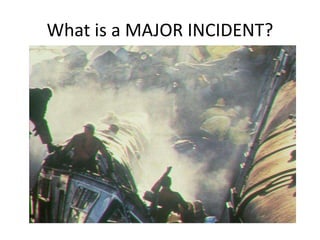
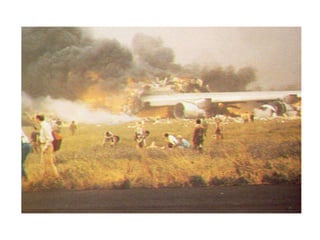
What is a MAJOR INCIDENT?
disaster cycle
disaster cycle
Major Incident Definition
• An incident where the
– NUMBER, SEVERITY, or TYPE of LIVE casualties, or
by its LOCATION, requires EXTRAORDINARY
resources.
Major Incident Definition
• An incident that presents a serious threat to
the health of the community
• An incident that disrupts the health service
Major Incident Classification
Compensated Uncompensated
Major Incident Classification
• Uncompensated
Major Incident
= DISASTER
PHASES OF DISASTER
• Pre-impact phase
• Impact phase
• Post-impact phase
What is Disaster Management
PHASES OF DISASTER MANAGEMENT
• Disaster Preparedness
• Disaster impact
• Disaster Response
• Rehabilitation - Recovery
• Disaster Mitigation
CSCATTT
• Command and Control
• Safety
• Communication
• Assessment
• Triage
• Treatment
• Transport
• Command
And
control
Command and control.
• Every group should have their Command.
• Every response area should have their
command.
• All of that – all the disaster response systems
should have higher command.
disaster cycle
Tiers of Command
Bronze
• Bronze area is the area of immediate hazard and casualty rescue.
• Its boundary is the Inner Cordon.
• There may be more than one BRONZE area within an incident.
Silver
• Silver area is the entire scene.
• Its boundary is the outer cordon.
• There is only one silver area within an incident.
Gold
• Gold area is remote from the scene.
• It may be identified by a local authority, regional, or national
boundary.
17
18
Safety On The Scene
• Safety Priorities
The following safety priorities should be observed:
Self
Scene
Survivors (Injured & uninjured)
19
Safety On The Scene
1- Personal Safety
Protective equipment:
High visibility jacket Protective boots
Hard hat Goggles or visors
Ear defenders Gloves
• Do Not approach the incident when hazards
are known to exist without permission of the
Bronze Fire Commander.
Safety On The Scene
2- Scene Safety
• Safety inside the Bronze area is the responsibility of
the Bronze Fire Commander especially in fire or
toxic chemicals.
• Safety inside the Silver area is the responsibility of
the Police who will evacuate any population at risk.
• If first on the scene, the Ambulance Commander
will take Control until additional resources arrive.
21
Safety On The Scene
3- Survivor Safety
 Occasionally it will be necessary to move casualties
if there is an immediate threat to life as fire or toxic
chemicals. This will be done without the usual
precautions (e.g. spinal immobilization).
 Measures must be taken to avoid additional
casualties by preventing hypothermia, heat illness,
exhaustion and dehydration.
22
Communications
Communication is always the most problematic part
of the plan.
Communication with:
• The staff
• The other responders
• The other health facilities
• The authorities
• The media
• The families
• The non-injured survivors
23
Communications
• Communications are mainly performed using the radio.
• The radio must be monitored at all times.
Alternative Methods for communications:
Face-to-face, runner (written message),
megaphone, whistle, hand signals, pager,
and mobile phones.
24
METHANE Report
M: My name.
Major incident STANDBY or DECLARED.
E: Exact location.
T: Type of incident.
H: Hazards, present and potential.
A: Access to scene, helicopter landing location.
N: Number and severity of casualties.
E: Emergency services, present and required.
Dealing with The Media
• All major incidents will attract a media response.
• The Silver Police Commander is responsible for
managing the media.
• Prepare a statement in advance if possible.
• Do Not be drawn into suppositions regarding the
cause and responsibility for the incident.
• In television interview:
Check your appearance: do you look professional?
Always assume that you are on the air.
Look straight at the interviewer, not the camera.
26
Triage
28
29
Treatment
Treatment Priorities in Casualty Clearing Station (CCS):
• Airway, and cervical spine control.
• Breathing, and oxygen.
• Circulation, and control of bleeding.
30
Major incident treatment limitations:
 Full spinal immobilization is impractical for all victims in a
rail crash for example, even though they are exposed to the
same injury.
 Oxygen is a limited source, so more than one patient can be
given oxygen from the same cylinder.
 Defibrillation is appropriate only for a witnessed cardiac
arrest, those with no vital signs should be pronounced
dead.
 Intubation has a limited role at the scene.
31
Transport
Casualty Evacuation Principles: (‫)إخالء‬
The Silver Ambulance Commander and the Ambulance
Loading Officer are responsible for the efficient use of
available transport for patient evacuation.
Immediate Priority 1
These casualties should be evacuated
by emergency ambulance, if appropriate
use ambulance helicopter.
32
Transport
Urgent Priority 2
These casualties might need to be moved by
emergency ambulance, but after Priority 1.
Transport
Delayed Priority 3
These casualties often do not need to be
moved by emergency ambulance, unless there
are adequate resources for all patients.
Medical Personnel on the scene
1. Silver ambulance commander
2. Bronze ambulance commander
3. Casualty clearing station (CCS) officer
4. Communications officer
5. Equipment officer
6. Loading officer
7. Parking officer
8. Primary triage officer
9. Safety officer
10. Secondary triage officer
35
disaster cycle

More Related Content

PPTX
Disaster management
PPTX
Vital statistics
PPTX
Disaster management and its planning
PPT
Disaster preparedness brisso
PPTX
Disaster Management
PPTX
Occupatinal health hazards
PPTX
Disaster Preparedness.pptx
PDF
Principles Of Emergency Planning
Disaster management
Vital statistics
Disaster management and its planning
Disaster preparedness brisso
Disaster Management
Occupatinal health hazards
Disaster Preparedness.pptx
Principles Of Emergency Planning

What's hot (20)

PPTX
Disaster management cycle, mitigation and preparedness
PPT
Psycho social issues in disaster management 2
PPTX
National health programmes
PPSX
Disaster management Community health
PPTX
National policy on disaster management
PPTX
High risk approach in maternal and child health
PPT
National Rural Health Mission
PPTX
School health Nursing
PPSX
Unit no 02 dm_disaster mitigation
PPTX
Maternal and child health programme
PDF
Slide to define about Hookworm infestation
PPT
Principles of disater management
PPTX
Disaster management principles
PPTX
Disaster management
PDF
PANCHAYAT RAJ COMMUNITY HEALTH powepoint prwsentation NURSING
PPTX
Media in Disaster Management
PPSX
Introduction of Community health nursing
PPT
Standing orders
PPT
disaster preparedness and response.ppt
PPTX
Community Health Nursing Process.pptx
Disaster management cycle, mitigation and preparedness
Psycho social issues in disaster management 2
National health programmes
Disaster management Community health
National policy on disaster management
High risk approach in maternal and child health
National Rural Health Mission
School health Nursing
Unit no 02 dm_disaster mitigation
Maternal and child health programme
Slide to define about Hookworm infestation
Principles of disater management
Disaster management principles
Disaster management
PANCHAYAT RAJ COMMUNITY HEALTH powepoint prwsentation NURSING
Media in Disaster Management
Introduction of Community health nursing
Standing orders
disaster preparedness and response.ppt
Community Health Nursing Process.pptx
Ad

Similar to disaster cycle (20)

PPTX
Kevin morrey maj ax cbrn.ppt
PPTX
Disaster management
PPTX
Unit 3 Disaster Management and emergency preparedness (2) (1).pptx
PPT
3 . Disaster management.ppt
PPTX
DISASTER MANAGEMENT
PPTX
Disaster Management
PPT
VICTIM EVACUATION 1_Patient Transportation.ppt
PPT
Disaster Management- 22.02.2023.ppt
PPT
Disaster Mgt. for on line trg.ppt
PDF
Triage, natural disaster, biowar, pandemic: Role of anesthesiologist
PPT
Emergency Response Management ppts .ppt
PPTX
Disaster disaster management during emer
PPT
Disaster management & airway adjuncts
PPTX
ONSITE MANAGEMENT,PPE AND DECONTAMI.pptx
PDF
Introduction to first aid.pdf
PPTX
DISASTER AND DISASTER NURSING PPT FOR NURSING STUDENTS
PDF
ACTEP2014: Hot zone
PDF
Natural and m an made disasters
PPT
Emergency Chemical Response Decontamination Principles and Patient Management
PPTX
Ems rtf ccp training
Kevin morrey maj ax cbrn.ppt
Disaster management
Unit 3 Disaster Management and emergency preparedness (2) (1).pptx
3 . Disaster management.ppt
DISASTER MANAGEMENT
Disaster Management
VICTIM EVACUATION 1_Patient Transportation.ppt
Disaster Management- 22.02.2023.ppt
Disaster Mgt. for on line trg.ppt
Triage, natural disaster, biowar, pandemic: Role of anesthesiologist
Emergency Response Management ppts .ppt
Disaster disaster management during emer
Disaster management & airway adjuncts
ONSITE MANAGEMENT,PPE AND DECONTAMI.pptx
Introduction to first aid.pdf
DISASTER AND DISASTER NURSING PPT FOR NURSING STUDENTS
ACTEP2014: Hot zone
Natural and m an made disasters
Emergency Chemical Response Decontamination Principles and Patient Management
Ems rtf ccp training
Ad

More from Dr. Ahmad Azab (8)

PPTX
Hospital Pre-disaster Phase.pptx
PPTX
Disability in trauma patient: meaning – and management.pptx
PPTX
Systematic approach to critically ill patient..pptx
PPTX
4-circulation emergencies.pptx
PPTX
Breathing Emergencies.pptx
PPTX
Airway Emergencies - by Dr. Ahmed Azab - ER consultant
PPTX
Do not disturb Emergency team
PPTX
C.P.R. and saving life
Hospital Pre-disaster Phase.pptx
Disability in trauma patient: meaning – and management.pptx
Systematic approach to critically ill patient..pptx
4-circulation emergencies.pptx
Breathing Emergencies.pptx
Airway Emergencies - by Dr. Ahmed Azab - ER consultant
Do not disturb Emergency team
C.P.R. and saving life

Recently uploaded (20)

PPTX
MANAGEMENT SNAKE BITE IN THE TROPICALS.pptx
PPTX
surgery guide for USMLE step 2-part 1.pptx
PPTX
Stimulation Protocols for IUI | Dr. Laxmi Shrikhande
PPT
Infections Member of Royal College of Physicians.ppt
PPTX
regulatory aspects for Bulk manufacturing
PPTX
obstructive neonatal jaundice.pptx yes it is
PPTX
Post Op complications in general surgery
PDF
SEMEN PREPARATION TECHNIGUES FOR INTRAUTERINE INSEMINATION.pdf
PPTX
Neuropathic pain.ppt treatment managment
PPT
Copy-Histopathology Practical by CMDA ESUTH CHAPTER(0) - Copy.ppt
PDF
Intl J Gynecology Obste - 2021 - Melamed - FIGO International Federation o...
PPTX
Acid Base Disorders educational power point.pptx
PPTX
Human Reproduction: Anatomy, Physiology & Clinical Insights.pptx
PPT
nephrology MRCP - Member of Royal College of Physicians ppt
PPT
Obstructive sleep apnea in orthodontics treatment
PPTX
IMAGING EQUIPMENiiiiìiiiiiTpptxeiuueueur
PPTX
Reading between the Rings: Imaging in Brain Infections
PDF
Cardiology Pearls for Primary Care Providers
PPTX
Cardiovascular - antihypertensive medical backgrounds
PPTX
1. Basic chemist of Biomolecule (1).pptx
MANAGEMENT SNAKE BITE IN THE TROPICALS.pptx
surgery guide for USMLE step 2-part 1.pptx
Stimulation Protocols for IUI | Dr. Laxmi Shrikhande
Infections Member of Royal College of Physicians.ppt
regulatory aspects for Bulk manufacturing
obstructive neonatal jaundice.pptx yes it is
Post Op complications in general surgery
SEMEN PREPARATION TECHNIGUES FOR INTRAUTERINE INSEMINATION.pdf
Neuropathic pain.ppt treatment managment
Copy-Histopathology Practical by CMDA ESUTH CHAPTER(0) - Copy.ppt
Intl J Gynecology Obste - 2021 - Melamed - FIGO International Federation o...
Acid Base Disorders educational power point.pptx
Human Reproduction: Anatomy, Physiology & Clinical Insights.pptx
nephrology MRCP - Member of Royal College of Physicians ppt
Obstructive sleep apnea in orthodontics treatment
IMAGING EQUIPMENiiiiìiiiiiTpptxeiuueueur
Reading between the Rings: Imaging in Brain Infections
Cardiology Pearls for Primary Care Providers
Cardiovascular - antihypertensive medical backgrounds
1. Basic chemist of Biomolecule (1).pptx

disaster cycle

  • 3. What is a MAJOR INCIDENT?
  • 6. Major Incident Definition • An incident where the – NUMBER, SEVERITY, or TYPE of LIVE casualties, or by its LOCATION, requires EXTRAORDINARY resources.
  • 7. Major Incident Definition • An incident that presents a serious threat to the health of the community • An incident that disrupts the health service
  • 9. Major Incident Classification • Uncompensated Major Incident = DISASTER
  • 10. PHASES OF DISASTER • Pre-impact phase • Impact phase • Post-impact phase
  • 11. What is Disaster Management
  • 12. PHASES OF DISASTER MANAGEMENT • Disaster Preparedness • Disaster impact • Disaster Response • Rehabilitation - Recovery • Disaster Mitigation
  • 13. CSCATTT • Command and Control • Safety • Communication • Assessment • Triage • Treatment • Transport
  • 15. Command and control. • Every group should have their Command. • Every response area should have their command. • All of that – all the disaster response systems should have higher command.
  • 17. Tiers of Command Bronze • Bronze area is the area of immediate hazard and casualty rescue. • Its boundary is the Inner Cordon. • There may be more than one BRONZE area within an incident. Silver • Silver area is the entire scene. • Its boundary is the outer cordon. • There is only one silver area within an incident. Gold • Gold area is remote from the scene. • It may be identified by a local authority, regional, or national boundary. 17
  • 18. 18
  • 19. Safety On The Scene • Safety Priorities The following safety priorities should be observed: Self Scene Survivors (Injured & uninjured) 19
  • 20. Safety On The Scene 1- Personal Safety Protective equipment: High visibility jacket Protective boots Hard hat Goggles or visors Ear defenders Gloves • Do Not approach the incident when hazards are known to exist without permission of the Bronze Fire Commander.
  • 21. Safety On The Scene 2- Scene Safety • Safety inside the Bronze area is the responsibility of the Bronze Fire Commander especially in fire or toxic chemicals. • Safety inside the Silver area is the responsibility of the Police who will evacuate any population at risk. • If first on the scene, the Ambulance Commander will take Control until additional resources arrive. 21
  • 22. Safety On The Scene 3- Survivor Safety  Occasionally it will be necessary to move casualties if there is an immediate threat to life as fire or toxic chemicals. This will be done without the usual precautions (e.g. spinal immobilization).  Measures must be taken to avoid additional casualties by preventing hypothermia, heat illness, exhaustion and dehydration. 22
  • 23. Communications Communication is always the most problematic part of the plan. Communication with: • The staff • The other responders • The other health facilities • The authorities • The media • The families • The non-injured survivors 23
  • 24. Communications • Communications are mainly performed using the radio. • The radio must be monitored at all times. Alternative Methods for communications: Face-to-face, runner (written message), megaphone, whistle, hand signals, pager, and mobile phones. 24
  • 25. METHANE Report M: My name. Major incident STANDBY or DECLARED. E: Exact location. T: Type of incident. H: Hazards, present and potential. A: Access to scene, helicopter landing location. N: Number and severity of casualties. E: Emergency services, present and required.
  • 26. Dealing with The Media • All major incidents will attract a media response. • The Silver Police Commander is responsible for managing the media. • Prepare a statement in advance if possible. • Do Not be drawn into suppositions regarding the cause and responsibility for the incident. • In television interview: Check your appearance: do you look professional? Always assume that you are on the air. Look straight at the interviewer, not the camera. 26
  • 28. 28
  • 29. 29
  • 30. Treatment Treatment Priorities in Casualty Clearing Station (CCS): • Airway, and cervical spine control. • Breathing, and oxygen. • Circulation, and control of bleeding. 30
  • 31. Major incident treatment limitations:  Full spinal immobilization is impractical for all victims in a rail crash for example, even though they are exposed to the same injury.  Oxygen is a limited source, so more than one patient can be given oxygen from the same cylinder.  Defibrillation is appropriate only for a witnessed cardiac arrest, those with no vital signs should be pronounced dead.  Intubation has a limited role at the scene. 31
  • 32. Transport Casualty Evacuation Principles: (‫)إخالء‬ The Silver Ambulance Commander and the Ambulance Loading Officer are responsible for the efficient use of available transport for patient evacuation. Immediate Priority 1 These casualties should be evacuated by emergency ambulance, if appropriate use ambulance helicopter. 32
  • 33. Transport Urgent Priority 2 These casualties might need to be moved by emergency ambulance, but after Priority 1.
  • 34. Transport Delayed Priority 3 These casualties often do not need to be moved by emergency ambulance, unless there are adequate resources for all patients.
  • 35. Medical Personnel on the scene 1. Silver ambulance commander 2. Bronze ambulance commander 3. Casualty clearing station (CCS) officer 4. Communications officer 5. Equipment officer 6. Loading officer 7. Parking officer 8. Primary triage officer 9. Safety officer 10. Secondary triage officer 35